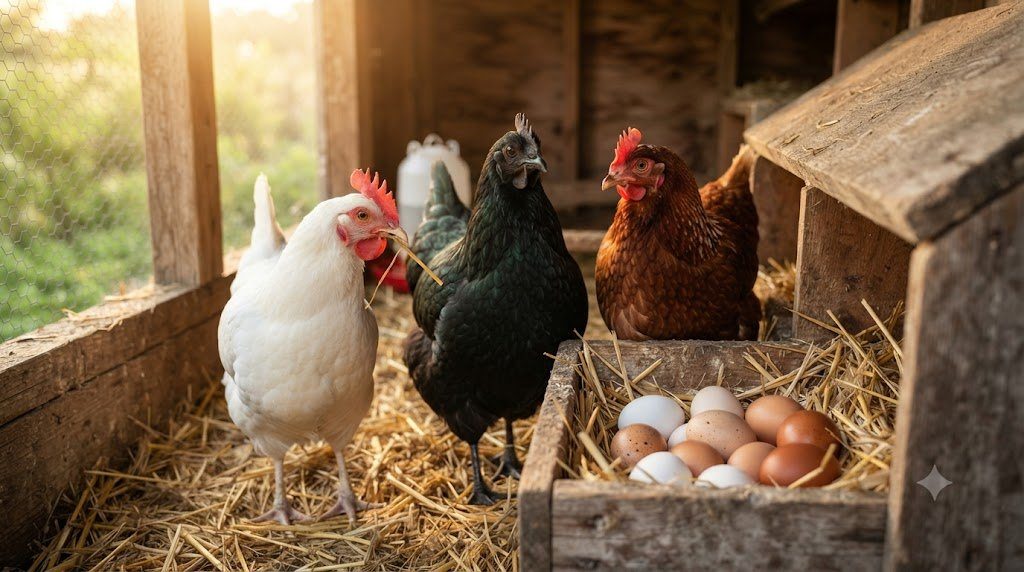
Commercial and heritage egg-laying chicken breeds—ranging from the industrial Single-Comb White Leghorn and four-way commercial Sex-Link Hybrids (ISA Brown, Lohmann Brown, Hy-Line W-36, Golden Comet, Black Star) to high-production heritage layers (Rhode Island Red, Australorp, Sussex) and polychromatic colored-egg specialists (Ameraucana, Cream Legbar, and French Black Copper Marans)—form one of the most genetically refined sectors in modern animal husbandry. Through quantitative Reciprocal Recurrent Selection (RRS), modern laying hens achieve a biological milestone once thought impossible: converting just 3.1 to 3.4 pounds of feed into a dozen Grade-A large eggs while laying 310 to 340 eggs per 52-week laying cycle. Mastering the avian hypothalamic-pituitary-gonadal (HPG) photoperiod axis, Z-chromosome sex-linked feather color genetics, shell gland calcium carbonate mineralization, and SLCO1B3 blue-egg retroviral insertions is essential for commercial and pasture-based egg operations.
The Z-Chromosome Sex-Linked Crossbreeding Mechanism
Unlike mammals where females are XX and males are XY, birds possess a ZW sex-determination system where males are homogametic (ZZ) and females are heterogametic (ZW). When a homozygous Gold/Red rooster (s+/s+ on the Z chromosome, such as a Rhode Island Red) is mated to a Silver hen (S/-W on the Z chromosome, such as a Rhode Island White or Delaware), 100% of hatchling cockerel chicks inherit a dominant Silver allele from their mother (S/s+ = creamy yellow-white down), while 100% of pullet chicks inherit only the Gold allele from their father (s+/-W = reddish-buff down). This enables 100% accurate visual sexing at one second of age without vent examination.
1. Taxonomic Classifications: Mediterranean White-Egg vs. Brown-Egg Hybrids
Egg-laying breeds are divided by the American Poultry Association (APA) Standard of Perfection and commercial genetics firms into three primary functional categories:
- Mediterranean Class White-Egg Specialists (White Leghorn, Ancona, Minorca): Originating in coastal Italy (the port of Livorno / Leghorn) and Spain. Characterized by a compact, lightweight metabolic body frame (3.5 to 4.2 lbs mature hen weight), tight feathering, large vascular single combs (which act as thermal radiators in hot climates), white earlobes, complete absence of maternal broodiness (prolactin suppression), and unmatched feed conversion efficiency into chalk-white eggs. Commercial strains (such as Hy-Line W-36 and Dekalb White) dominate global conventional and aviary table-egg production.
- Commercial Four-Way Sex-Link Brown Hybrids (ISA Brown, Lohmann Brown, Novogen, Golden Comet): Synthesized from four distinct grandparent pure lines of selected Rhode Island Red and Rhode Island White bloodlines. Weighing 4.2 to 4.6 pounds at maturity, commercial brown hybrids exhibit docile, non-flighty temperaments ideal for pasture-raised mobile coops and cage-free aviaries, laying 315 to 335 uniform rich brown eggs by 72 weeks of age.
- Heritage Dual-Purpose Brown Layers (Rhode Island Red, Black Australorp, Barred Plymouth Rock): Developed in the 19th and early 20th centuries across New England and Australia. An official Black Australorp holds the verified world heritage trap-nest record of 364 eggs in 365 days. While slightly heavier (5.5 to 6.5 lbs) with higher maintenance feed consumption than Leghorns, heritage breeds breed true generation after generation and tolerate harsh winter cold via smaller combs.
- Colored-Egg & Auto-Sexing Breeds (Ameraucana, Cream Legbar, Black Copper Marans, Welsummer): Prized by direct-to-consumer pasture farms for ‘Rainbow Cartons’ commanding $8 to $12 per dozen. Ameraucanas and Cream Legbars lay sky-blue eggs; Black Copper Marans and Welsummers lay deep terracotta/chocolate-brown eggs; and F1 crosses between a Marans rooster and an Ameraucana hen produce ‘Olive Eggers’ laying moss-green eggs.
2. Comparative Laying Hen Performance and Feed Efficiency Metrics
Evaluating commercial hybrids alongside premier heritage and specialty egg breeds illustrates the trade-offs between body maintenance weight, annual egg count, and shell pigmentation:
The reason a 3.6-pound White Leghorn requires 28% less feed per dozen eggs than a 6.2-pound heritage Plymouth Rock or Marans is pure thermodynamics: approximately 65% of a laying hen’s daily caloric intake goes simply toward maintaining basal body temperature (105°F to 107°F) and feather coverage. Reducing body mass by 2.5 pounds saves 32 pounds of feed per hen annually.
3. Biochemical Genetics of Eggshell Pigmentation (Biliverdin vs Protoporphyrin IX)
All avian eggshells are composed of 96% crystalline calcium carbonate ($CaCO_3$ calcite polymorphs) precipitated around a collagenous protein matrix inside the shell gland (uterus) over a 20-hour mineralization window. Shell color is determined entirely by two tetrapyrrole pigments derived from hemoglobin catabolism:
- White Eggs (No Pigment Deposition): In Leghorns, Anconas, and Minorcas, neither pigment is secreted into the shell gland lumen; the pure calcium carbonate crystal reflects white light.
- Blue Eggs (Oocyanin / Biliverdin + SLCO1B3 Retrovirus): Originating in the Mapuche indigenous Araucana fowl of Chile, blue eggshell color is governed by an autosomal dominant mutation ($O$, Oocyan) on chromosome 1. Genomic sequencing proved that the $O$ allele is an ancient EAV-HP endogenous retroviral insertion upstream of the SLCO1B3 (Solute Carrier Organic Anion Transporter 1B3) gene. This viral promoter causes ectopic expression of the bile-salt transporter inside the shell gland epithelium, pumping blue-green biliverdin-IX directly into the calcifying calcium carbonate matrix throughout the entire 20-hour shell formation process. Consequently, a blue egg is blue all the way through—both inside and outside the shell.
- Brown & Chocolate Eggs (Protoporphyrin IX Cuticle Coating): In brown-egg breeds (Rhode Island Red, Marans, Welsummer), the calcified shell itself is completely white on the inside during the first 18 hours of formation! Only during the final 90 minutes prior to oviposition (laying) do epithelial cells secrete reddish-brown protoporphyrin-IX into the proteinaceous outer cuticle (bloom). If you gently rub a fresh wet Marans egg, the dark chocolate pigment wipes right off, revealing white calcium underneath.
- Olive & Sage Green Eggs (F1 Epistatic Interaction): When a dark-brown-egg rooster (Black Copper Marans) is bred to a homozygous blue-egg hen (Ameraucana or Cream Legbar, $O/O$), 100% of the F1 pullets inherit the dominant $O$ allele (making a blue shell base) plus polygenic brown protoporphyrin genes (laying a dark brown outer cuticle over the blue shell)—producing a rich olive-green egg.
The Lethal Tufted (Et) Gene in True Araucanas vs. Ameraucanas
True APA Araucana chickens are rumpless (lacking a pygostyle tailbone) and carry the dominant Ear-Tuft gene (Et). However, the Et gene is 100% embryonic lethal when homozygous (Et/Et chicks die in the shell at day 18–20 of incubation) and causes 20% mortality even in heterozygotes. For commercial blue-egg production, breeders utilize the American ‘Ameraucana’ (which has a full tail, beard/muffs instead of lethal ear tufts, and slate legs) or the auto-sexing British ‘Cream Legbar’, achieving 95%+ hatchability with zero lethal genes.
4. Avian Photoperiod Endocrinology and the 25-Hour Ovulatory Cycle
Unlike mammals where light is processed solely through retinal ganglion cells, birds possess deep encephalic (hypothalamic) photoreceptors located directly inside the brain beneath the thin parietal skull bones. Red-orange wavelength light (630 to 700 nm) penetrates the skull directly to stimulate hypothalamic Gonadotropin-Releasing Hormone (GnRH-I) neurons:
- The 14- to 16-Hour Photoperiod Requirement: As autumn day length drops below 12 hours, GnRH-I secretion ceases, the ovary regresses from 50 grams down to 4 grams, and hens stop laying and initiate their annual feather molt. To maintain winter egg production, commercial houses provide 14 to 16 hours of continuous warm-spectrum (2700K–3000K) LED light at 10 to 15 lux intensity, using automatic morning timers so dusk stays natural.
- Never Stimulate Pullets Before Mature Body Weight: Increasing light duration on juvenile pullets before 17 to 18 weeks of age (before medullary bone reserves are built) triggers premature ovulation of double-yolk eggs into an immature oviduct, causing fatal cloacal/oviductal prolapse (‘pickout’).
- The 25-Hour Oviposition Clutch Lag: Forming a single egg takes 24 to 26 hours (15 minutes in the infundibulum for fertilization, 3 hours in the magnum for albumen white secretion, 1.25 hours in the isthmus for shell membranes, and 20 hours in the uterus/shell gland). Because ovulation occurs 30 minutes after the previous egg is laid, a hen lays slightly later each day until she hits afternoon darkness, skips one day (‘pause day’), and resets her clutch at dawn.
5. Medullary Bone Calcium Metabolism and Layer Ration Formulation
Every large eggshell contains approximately 2.0 to 2.2 grams of pure elemental calcium (5.5 grams of calcium carbonate). Because a high-producing Leghorn or ISA Brown deposits over 650 grams of pure calcium into eggshells each year—equivalent to 25 times the total calcium content of her entire skeleton—she relies on specialized Medullary Bone woven inside the marrow cavities of her femur and tibiotarsus:
Crucially, because shell calcification occurs primarily at night when the hen is sleeping on the roost with an empty crop, 50% to 65% of dietary calcium must be supplied as coarse, large-particle limestone or crushed oyster shell (2 to 4 mm particle size). Large calcium particles are retained in the muscular gizzard overnight, dissolving slowly in hydrochloric acid to supply a continuous bloodstream stream of $Ca^{2+}$ ions to the shell gland without resorbing structural cortical bone (which causes Cage Layer Fatigue / osteoporosis).
6. Veterinary Biosecurity: Marek’s Disease, Infectious Bronchitis, and Avian Influenza
Protecting laying flocks over an 18- to 24-month production cycle requires day-one hatchery immunization and vector biosecurity:
- Marek’s Disease (Gallid Alphaherpesvirus 2): An ubiquitous, oncogenic herpesvirus inhaled via feather-follicle dander that causes T-cell lymphomas in visceral organs and sciatic nerve paralysis in pullets aged 10 to 25 weeks. Prevented strictly by in-ovo or Day-1 hatchery subcutaneous vaccination with HVT (Herpesvirus of Turkeys) + Rispens CVI988 bivalent vaccine, followed by 14 days of strict brooder quarantine while immunity develops.
- Infectious Bronchitis Virus (IBV) & Egg Drop Syndrome: Coronavirus infection of the magnum and shell gland causes permanent oviduct scarring, resulting in wrinkled, corrugated eggshells and watery, thin albumen (low Haugh Units). Prevented via live attenuated drinking-water or spray vaccination during pullet rearing.
- Northern Fowl Mite & Red Poultry Mite (Dermanyssus gallinae): Hematophagous ectoparasites that cause vent anemia, pale combs, and a 15% to 30% drop in egg production. Controlled via elemental sulfur dust baths, diatomaceous earth/kaolin clay roost coatings, or spinosad premise treatments.
7. Enterprise Economics: Pasture-Raised Mobile Egg Operations
In commercial pasture-raised egg enterprises (utilizing mobile solar ‘Eggmobiles’ moved every 3 to 4 days behind grazing beef cattle), a flock of 1,000 ISA Brown or Hy-Line Brown hens lays an average of 72 dozen marketable eggs per day (26,280 dozen/year). At wholesale/direct-retail pasture-raised prices of $5.50 to $7.50 per dozen, each hen generates $144 to $195 in annual gross egg revenue against $42 to $52 in annual feed and pullet depreciation costs—yielding $90,000 to $130,000 in net labor and management return per 1,000-hen mobile unit.
8. Frequently Asked Questions (Technical Egg-Laying Poultry Genetics FAQ)
Q: Can you tell what color egg a hen will lay by looking at the color of her earlobes?
In most traditional breeds, yes: Mediterranean breeds with white earlobes (Leghorns, Anconas, Minorcas) lay white eggs because purine pigment crystals are deposited in the earlobe skin while shell pigment is absent. Breeds with red earlobes (Rhode Island Reds, Orpingtons, Plymouth Rocks) lay brown eggs. However, notable exceptions exist: Araucanas, Ameraucanas, and Cream Legbars have red or cream earlobes and lay blue eggs, while Penedesencas and Dorkings have white/red-tinted earlobes with unique shell colors.
Q: What is the difference between a true Ameraucana, an Araucana, and a hatchery ‘Easter Egger’?
True APA Araucanas are rumpless and tufted (carrying the lethal Et gene) and lay blue eggs. True APA Ameraucanas have full tails, pea combs, beards/muffs, slate-blue legs, breed true to 8 strict color varieties, and are homozygous (O/O) for blue eggs. ‘Easter Eggers’ are non-standard crossbred hybrids carrying at least one copy of the blue-egg gene; they do not breed true and may lay blue, green, olive, or tinted pink-brown eggs.
Q: Why do Black Copper Marans eggs become lighter in color from spring to late autumn?
A Marans hen produces a relatively fixed quantity of protoporphyrin-IX pigment in her shell gland during each laying cycle. Early in the spring laying season (or right after a winter molt), high pigment reserves coat a smaller egg in deep #7 to #8 chocolate pigment. As the season progresses and egg surface area increases while glandular pigment stores deplete, the shells gradually lighten to #4 or #5 medium terracotta until her next annual molt resets the gland.
Q: Why must baby chicks and growing pullets never be fed adult Layer Ration?
Adult Layer Ration contains 3.8% to 4.2% calcium—four times the 1.0% calcium level safe for growing chicks. Feeding high-calcium layer feed to chicks under 16 weeks of age overwhelms their immature kidneys, causing fatal visceral gout, renal tubular calcification, nephritis, and permanent skeletal stunting.
Q: How does an Auto-Sexing breed (like the Cream Legbar) differ from a Sex-Link hybrid (like the ISA Brown)?
A Sex-Link hybrid (Red Star, Black Star, ISA Brown) is a first-generation (F1) cross between two different breeds; if you breed an ISA Brown hen to an ISA Brown rooster, the second-generation chicks will NOT be sexable by color. An Auto-Sexing breed (Cream Legbar, Bielefelder, Welbar) is a purebred breed homozygous for the sex-linked Barred (B) gene on a silver/gold background; when bred pure (Cream Legbar x Cream Legbar), male and female chicks are 100% visually distinct at hatch forever.
Q: Why is coarse limestone or oyster shell superior to finely ground calcium powder for eggshell strength?
Finely ground limestone passes rapidly through the gizzard and small intestine during daytime feeding hours, leaving the hen’s bloodstream depleted of calcium at 2:00 AM when the shell gland is actively calcifying the egg. Coarse 2–4 mm calcium grit lodges in the gizzard and dissolves slowly all night long, preventing thin shells and osteoporosis.
Q: What is a Haugh Unit, and how do genetics and storage temperature affect it?
Invented by Raymond Haugh in 1937, the Haugh Unit measures internal egg protein quality by weighing the egg and measuring the height of the thick albumen (white) with a micrometer when broken onto a flat glass plate. Fresh Grade AA eggs score above 72 Haugh Units (often 85–95 at lay). High temperatures and infectious bronchitis virus degrade ovomucin protein fibers, causing the white to flatten into a watery puddle.
Q: Why do commercial brown-egg layers sometimes lay eggs with tiny brown ‘meat spots’ or blood spots?
Brown-egg breeds are genetically more prone to tiny capillary ruptures on the ovarian follicle stigma during ovulation (causing a pinpoint blood spot on the yolk) or sloughing tiny oxidized protoporphyrin pigment/tissue specks in the oviduct (‘meat spots’ in the albumen). While harmless to eat, commercial packing plants remove them using high-speed spectrophotometric optical candlers.