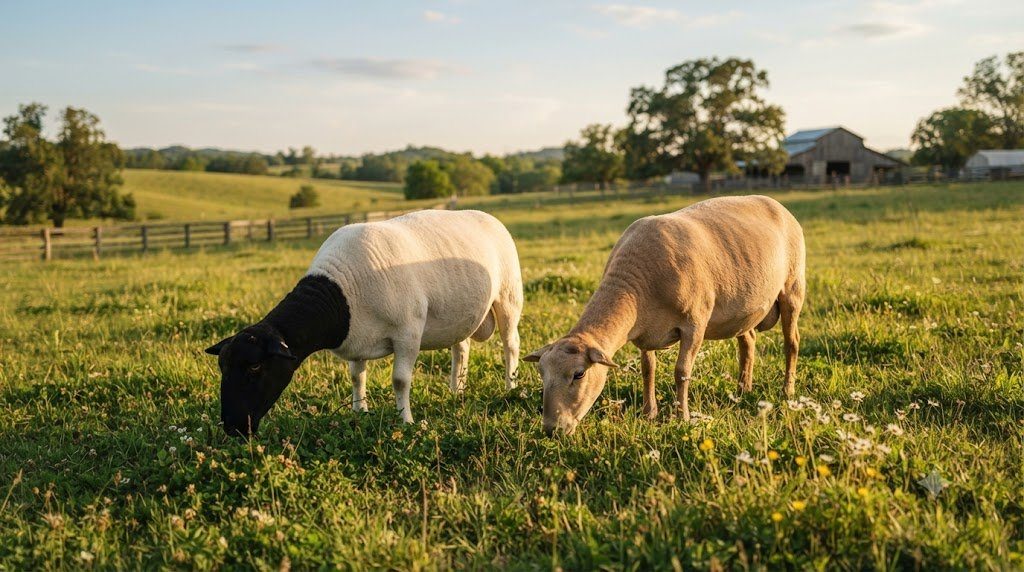
Self-shedding hair sheep breeds—led by the American Katahdin, the South African Dorper and White Dorper, the Caribbean St. Croix and Barbados Blackbelly, and the composite Royal White—represent the fastest-growing segment of the global ovine industry. Unlike wooled sheep whose secondary follicles grow continuous wool fibers requiring annual mechanical shearing and tail docking, hair sheep retain the ancestral wild ovine seasonal coat cycle: growing a winter insulating undercoat of fine wool fibers beneath coarse hair shafts in autumn and shedding (moulting) the entire fleece naturally each spring. Combining zero shearing expenses, innate immunological resistance to Haemonchus contortus nematodes, aseasonal polyestrous fertility, and mild-flavored gourmet meat (low branched-chain fatty acids), hair sheep have revolutionized pasture-based sheep ranching across humid, temperate, and subtropical regions.
The Economic Reality of Shearing Elimination
In many non-fine-wool sheep regions, hiring a professional shearer costs $6.00 to $10.00 per ewe, while coarse meat-type wool sells for less than $0.40 per pound—resulting in a net cash loss on every shearing day alongside labor-intensive crutching and flystrike treatments. Self-shedding hair sheep completely eliminate shearing, crutching, and tail-docking labor while weaning 180% to 220% lamb crops on grass.
1. Historical Origins, Genetic Synthesis, and Hair Sheep Classifications
Hair sheep trace their root hair-coat and parasite-resistance alleles to West African landraces (such as the Djallonké and Sahelian sheep) transported to the Caribbean basin and Brazil during the 16th and 17th centuries, later crossed with European meat breeds to create modern commercial composites:
- Katahdin (United States): Developed beginning in 1957 by amateur geneticist Michael Piel in Abbot Village, Maine, and named after Mount Katahdin. Piel imported Virgin Islands hair sheep (St. Croix types) and crossed them with British Down and meat breeds (Suffolk, Hampshire, Southdown, and Wiltshire Horn), selecting over 20 years for a medium-framed, meaty, prolific, completely shedding maternal sheep. Today, the Katahdin leads all U.S. sheep registries in annual registrations and NSIP genomic participation.
- Dorper & White Dorper (South Africa): Developed in the 1930s by the South African Department of Agriculture and arid Karoo ranchers by crossing the horned Dorset Horn ram with the black-headed Blackhead Persian fat-rump hair ewe (Dor-per = Dorset + Persian). Available in both classic Black-headed Dorper and pure White Dorper registries, the Dorper is the premier muscular terminal hair breed, displaying thick barrel conformation, rapid weight gain, and valuable ‘Cape Glovers’ leather pelts.
- St. Croix (Virgin Islands White): Evolved on the Caribbean island of St. Croix from West African Djallonké hair sheep without European wool introgression. Pure white, polled, medium-framed, and exceptionally prolific, the St. Croix possesses the strongest documented genetic immunity to Haemonchus contortus of any sheep breed in the world.
- Barbados Blackbelly & American Blackbelly: Originating on the island of Barbados from West African hair sheep crossed with early Dutch prolific sheep. Purebred Barbados Blackbellies are polled (both sexes), displaying a striking reddish-tan to mahogany body with jet-black markings across the belly, throat, inner legs, and facial badger stripes. The American Blackbelly was created by crossing Barbados Blackbellies with Mouflon and Rambouillet rams to develop dramatic sweeping spiral horns in trophy rams.
- Royal White & Wiltshire Horn: The Royal White was developed by Bill Hoag in Hermleigh, Texas, in the 1990s as a large-framed, pure white composite combining St. Croix and Dorper genetics. The Wiltshire Horn is an ancient British native shedding breed from chalk downs, horned in both sexes with a coarse white hair coat and heavy terminal size.
2. Comparative Hair Sheep Breed Production Benchmarks
Comparing the five major hair sheep breeds illustrates the strategic division between low-input maternal parasite specialists (St. Croix and Katahdin) and muscular terminal carcass builders (Dorper and Royal White):
In commercial grass-fed lamb systems across the humid Midwest, Mid-Atlantic, and Southeast, the optimal production model mimics the Kiko-Boer goat cross: maintaining a maternal flock of NSIP-recorded Katahdin or St. Croix x Katahdin ewes and breeding them to thick-muscled White Dorper, Dorper, or Texel terminal rams.
3. Immunogenetics of St. Croix & Katahdin Haemonchus Resistance
Extensive veterinary parasitology research at Louisiana State University, Virginia Tech, and West Virginia University has elucidated the exact cellular mechanism by which St. Croix and high-EBV Katahdin sheep resist Haemonchus contortus (Barber Pole Worm) infection without dewormers:
The Immediate Mucosal Th2 Immune Exclusion Mechanism
When an infective L3 Haemonchus larva is ingested on grass by a susceptible Suffolk or Merino sheep, the larva burrows unimpeded into the abomasal gastric glands, molts into a blood-sucking L4/adult within 14 days, and drains 0.05 mL of blood per worm daily. In a St. Croix or low-WEC Katahdin sheep, abomasal pattern-recognition receptors trigger an immediate Type-2 Helper T-cell (Th2) cytokine surge (Interleukin-4, IL-5, and IL-13) within 48 hours of larval ingestion. Massive infiltration of mucosal mast cells, globule leukocytes, eosinophils, and parasite-specific IgA antibodies paralyzes and expels 95% to 99% of L3 larvae before they can ever molt into blood-feeding L4 stages.
Through the National Sheep Improvement Program (NSIP), Katahdin breeders measure Weaning Fecal Egg Count (WFEC) and Post-Weaning Fecal Egg Count (PFEC) EBVs ranging from $+200\%$ (highly susceptible) down to $-98\%$ (nearly complete resistance). Purchasing a Katahdin ram with a $-85\%$ PFEC EBV cuts whole-flock pasture larval contamination in half within a single generation.
4. Coat Shedding Classification (A, B, C, D Coats) and Prolactin Cycles
Seasonal shedding in hair sheep is regulated by the vernal (spring) surge in pituitary prolactin as day length increases after the spring equinox. Prolactin induces synchronized telogen regression in wool and hair follicles, causing the winter coat to peel off in clean sheets by May or June. Katahdin Hair Sheep International (KHSI) Inspectors grade coats into four distinct phenotypes:
- ‘A’ Coat (Ideal Pure Hair): Consists entirely of smooth, glossy guard hair with minimal winter wool undercoat; sheds effortlessly and completely each spring.
- ‘B’ Coat (Double Coat – Sheds Cleanly): Grows a thick, plush winter wool-and-hair double coat that provides superior insulation during sub-zero northern winters, yet sheds 100% cleanly down to sleek summer hair once warm weather arrives. Highly prized in northern states.
- ‘C’ Coat (Incomplete Shedder): Retains unshed patches of matted wool over the saddle, back, or hips past July 1st; requires partial clipping or selection against in hot climates.
- ‘D’ Coat (Non-Shedding Woolly – Cull): Inherited excessive wool alleles; fails to shed naturally and is disqualified from Katahdin registry inspection.
5. Meat Flavor Biochemistry: Branched-Chain Fatty Acids and Consumer Appeal
A major driver of premium restaurant and retail demand for Katahdin, Dorper, and St. Croix lamb is its remarkably mild, sweet flavor profile—completely lacking the pungent ‘muttony’ or ‘woolly’ odor disliked by many North American consumers.
Meat science gas-chromatography studies demonstrate that the strong ‘mutton’ aroma in traditional wooled sheep is caused by volatile medium-chain branched-chain fatty acids (BCFAs)—specifically 4-methyloctanoic acid (MOA) and 4-methylnonanoic acid (MNA)—alongside skatole (3-methylindole) stored in subcutaneous fat and lanolin sebaceous glands. Hair sheep deposit 45% to 65% lower concentrations of 4-methyloctanoic acid in their carcass adipose tissue, allowing grass-fed hair lambs to be harvested up to 10 to 12 months of age with delicate, clean culinary flavor.
6. Tail Morphology, Undocked Welfare, and Accelerated Grazing
Unlike wooled sheep whose woolly tails collect wet manure and attract fatal blowfly strike unless docked at birth, purebred Katahdin, St. Croix, and Barbados Blackbelly sheep possess a narrower, tapered, hair-covered tail with a bare ventral underside:
- Zero Tail-Docking Requirement: Leaving tails completely intact on Katahdin, St. Croix, and Blackbelly lambs eliminates neonatal docking pain, prevents rectal prolapse (which is linked to ultra-short tail docking damaging perineal innervations), and allows the sheep to flick flies away from the anus and vulva. (Note: Purebred Dorpers have thicker fat-rump tails and are often docked at the third caudal vertebra).
- Multi-Species Rotational Grazing (Flerd Management): Hair sheep integrate seamlessly with beef cattle in a single ‘flerd’ (flock + herd) behind 3- or 4-strand high-tensile polywire electric fencing. Because cattle and sheep do not share internal gastrointestinal nematodes (cattle digest Haemonchus contortus larvae harmlessly, and sheep digest bovine Ostertagia larvae), co-grazing acts as a biological vacuum cleaner that sanitizes pastures while sheep consume broadleaf pasture weeds (ragweed, plantain, dock, spotted knapweed) ignored by cattle.
7. Enterprise Economics: Low-Input Grass-Fed Lamb Profitability
The economic brilliance of hair sheep lies in their ultra-low overhead cost structure. A 140-pound Katahdin ewe requires zero shearing, zero tail docking, minimal hoof trimming, and minimal deworming, while breeding out of season to produce 3 lamb crops every 2 years (or an annual 200% spring twin crop). Weaning 1.95 lambs per ewe at 85 to 100 pounds directly off rotational clover-grass pasture—and selling into ethnic, halal, or direct-to-consumer grass-fed markets at $2.80 to $3.50/lb live weight—generates $460 to $620 in gross revenue per ewe against annual pasture and mineral costs under $110 per ewe.
8. Frequently Asked Questions (Technical Hair Sheep Genetics FAQ)
Q: Do hair sheep survive sub-zero northern winters in states like Maine, Minnesota, or Montana?
Yes. Remember that the Katahdin breed was developed in north-central Maine! During autumn, hair sheep (especially those with ‘B’ double coats) grow a thick, insulating winter undercoat of fine wool fibers beneath their guard hair, easily tolerating -20°F temperatures as long as they have a dry windbreak and adequate hay.
Q: Why is the St. Croix considered the gold standard for natural parasite immunity?
Evolving in the warm, humid Virgin Islands without anthelmintic drugs, St. Croix sheep mount an immediate Th2 mucosal immune response within 48 hours of ingesting Haemonchus contortus L3 larvae. Eosinophils, mast cells, and IgA antibodies expel over 98% of larvae before they can attach to the abomasum and suck blood.
Q: What is the difference between a Black-headed Dorper and a White Dorper?
Both originate from the South African Dorset Horn x Blackhead Persian cross and share identical muscular carcass conformation and growth rates. White Dorpers were selectively bred from white recessives and Dorset backcrosses to eliminate black pigment fibers, making them preferred by pelters and breeders crossing onto white Katahdin or St. Croix ewes.
Q: Why does meat from Katahdin and Dorper hair sheep taste milder than wool sheep meat?
Wool sheep synthesize higher levels of volatile branched-chain fatty acids (4-methyloctanoic and 4-methylnonanoic acid) associated with sebaceous lanolin production, which give cooked mutton a strong aroma. Hair sheep have minimal lanolin glands and 50%+ lower branched-chain fatty acid levels, resulting in a mild, sweet flavor.
Q: Why should Katahdin and St. Croix lambs never have their tails docked?
Hair sheep have low-set, hair-covered tails that naturally lift cleanly during defecation without accumulating manure tags or attracting blowflies. Leaving tails intact eliminates neonatal surgical stress, prevents bacterial tetanus/arthritis entry wounds, and completely prevents short-dock rectal prolapses.
Q: What is the difference between a purebred Barbados Blackbelly and an American Blackbelly?
Purebred Barbados Blackbelly sheep (direct Caribbean island descendants) are naturally polled (hornless) in both rams and ewes and are conserved as a rare heritage breed. American Blackbelly sheep were created in the U.S. by crossing Barbados Blackbellies with horned Mouflon and Dorset/Rambouillet sheep so that rams grow massive, spiral trophy horns.
Q: How do NSIP Fecal Egg Count (WFEC / PFEC) EBVs work when buying a Katahdin ram?
In NSIP flocks, fecal samples are collected from all contemporary lambs at weaning and post-weaning to count parasite eggs per gram (EPG). Genomic BLUP calculates the genetic EBV: a ram with a -80% PFEC EBV carries genes that reduce worm egg shedding by 80% compared to the breed baseline, passing natural parasite resistance to his daughters.
Q: What is a ‘Cape Glovers’ sheepskin pelt from a Dorper?
Dorper sheep possess a thick, high-collagen dermal skin layer (comprising up to 10% of carcass weight, compared to 6% in wooled sheep) with tight, smooth grain free of pinhole wool follicle defects. Tanners prize Dorper skins as ‘Cape Glovers’ leather for luxury dress gloves, garments, and chamois.