Meat and dual-purpose chicken breeds span a remarkable genetic spectrum: from the four-way terminal Commercial Cornish Cross Broiler (Cobb 500, Ross 308, Hubbard Efficiency Plus) and intermediate slow-growing pasture hybrids (Freedom Ranger / Red Ranger, Kosher King, Sasso) to historic culinary table breeds (French AOC Bresse Gauloise, Dorking, Delaware) and dual-purpose homestead standards (Plymouth Rock, Wyandotte, Orpington, Sussex, and giant Jersey Giant / Brahma). Modern quantitative poultry breeding has reduced the time required to grow a 6.0-pound market broiler from 112 days in 1950 down to just 38 to 42 days today at a feed conversion ratio (FCR) of 1.55:1 to 1.68:1. Understanding the polygenic breast-muscle hypertrophy of terminal broilers, pulmonary hypertension (ascites) prevention, and the myofibrillar flavor chemistry of slow-grown heritage capons and roasters is fundamental to profitable poultry meat production.
The Four-Way Terminal Cornish Cross Breeding Pyramid
A commercial Cornish Cross broiler chick is never a simple two-breed cross; it is the terminal product of a four-way pedigree pyramid. Great-grandparent pure lines of White Cornish (selected for massive pectoralis major breast width and feed conversion) create the AB hybrid paternal sire line, while pure lines of White Plymouth Rock (selected for egg production, hatchability, and maternal vigor) create the CD hybrid maternal dam line. Crossing the AB rooster with the CD hen produces the ABCD terminal broiler—capturing 100% paternal and maternal heterosis.
1. Genetic Classifications: Terminal Broilers, Slow Rangers, and Heritage Dual-Purpose
Meat poultry breeds are categorized into four distinct metabolic and growth tiers that dictate housing, ration protein density, and target market channels:
- Fast-Growing Commercial White Broilers (Cobb 500, Ross 308, Ross 708): Derived from dominant-white Cornish sire lines crossed onto White Plymouth Rock dam lines. Engineered for explosive juvenile myogenesis, reaching 5.5 to 6.5 pounds live weight in 38 to 42 days (or 8.5 to 9.5 lbs in 52 days for deboned breast meat lines like Ross 708). Yielding a 72% to 75% dressed carcass with breast meat accounting for over 26% to 30% of live weight, they dominate global retail and foodservice poultry.
- Colored Slow-Growing Pasture Hybrids (Freedom Ranger, Redbro, Sasso, Pioneer): Developed in France during the 1960s to satisfy the prestigious Label Rouge free-range poultry standard (which mandates a minimum 81-day outdoor growing period). Reaching 5.5 to 6.5 pounds in 65 to 84 days with red, bronze, or barred plumage, strong leg structure, and active foraging instincts, they excel in pasture mobile-pen and day-range systems without leg paralysis or heart failure.
- Gourmet Heritage Meat Specialists (French Bresse, Dark Cornish, Silver-Grey Dorking, Delaware): The white-feathered, blue-legged Poulet de Bresse is protected under French AOC law as the world’s most expensive table chicken, famous for delicate intramuscular fat marbling when finished for 14 days on soaked white corn and buttermilk in darkened épinettes. The Delaware (created in 1940 from Barred Rock x New Hampshire crosses) was America’s premier broiler before the Cornish Cross era.
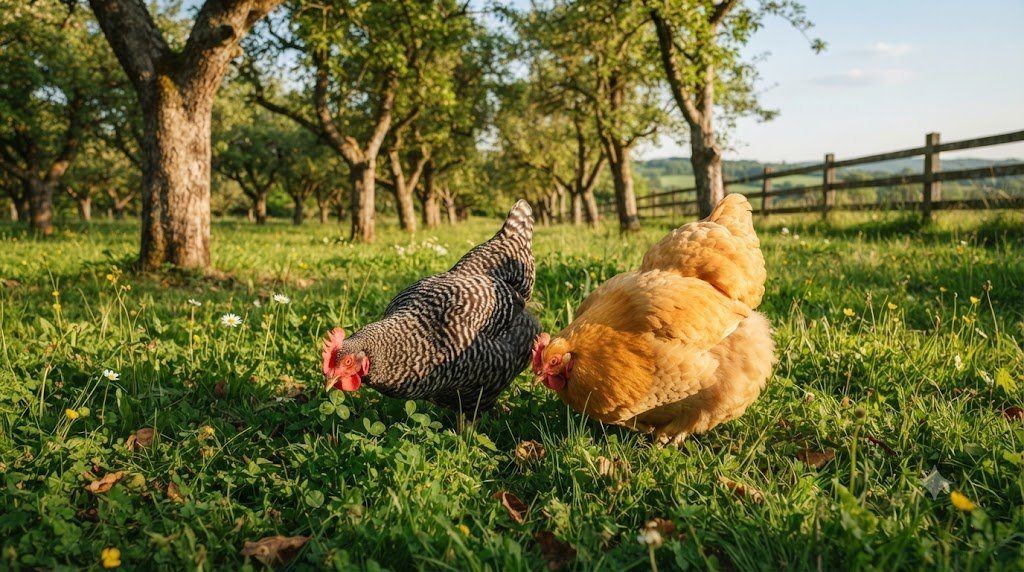
- Heavy & Giant Dual-Purpose Breeds (Barred/White Plymouth Rock, Buff Orpington, Wyandotte, Light Sussex, Jersey Giant, Brahma): Classic American and English breeds where hens lay 180 to 230 brown eggs annually while surplus cockerels dress out at 4.5 to 6.5 pounds at 16 to 22 weeks of age. The Black Jersey Giant (reaching 13 lbs in cocks) was bred in New Jersey in the 1870s specifically to replace the turkey as a massive roasting bird.
2. Comparative Growth Rate, Carcass Yield, and Feed Conversion Benchmarks
Analyzing the four meat production tiers highlights the dramatic biological divergence in growth velocity, feed conversion ratio (FCR), and breast-to-dark-meat proportions:
Notice the economic math: raising a Cornish Cross to a 4.5-pound dressed carcass requires only 10.0 pounds of broiler feed over 6 weeks. Raising a heritage Plymouth Rock or Orpington cockerel to the exact same 4.5-pound carcass weight requires 24 to 27 pounds of feed over 18 weeks—explaining why heritage pasture-raised chicken must command $7.50 to $11.00 per pound retail to remain profitable.
3. Myopathies of Rapid Hypertrophy: Wooden Breast, White Striping, and Ascites
In ultra-fast-growing Cornish Cross broilers, the cross-sectional diameter of individual glycolytic Type IIB muscle fibers in the pectoralis major breast muscle expands by over 500% in 40 days, occasionally outstripping capillary vascular angiogenesis and cardiopulmonary oxygen delivery:
Controlling Cardiopulmonary Ascites (‘Waterbelly’) and Sudden Death Syndrome
Because a Cornish Cross chick’s skeletal muscle mass grows much faster than its heart and lungs, excessive metabolic demand during cold brooder nights or at high elevations (> 3,500 ft) forces the right ventricle of the heart to pump furiously against pulmonary arterial resistance. This causes right-ventricular hypertrophy, valvular failure, and leakage of yellow ascitic fluid into the abdominal cavity (‘Waterbelly’) or acute ventricular fibrillation (‘Flip-Over Disease’ where the heaviest birds die suddenly on their backs). Producers prevent ascites and tibial dyschondroplasia by implementing a strict ’12-Hours-On, 12-Hours-Off’ feed restriction schedule starting at Day 14.
Similarly, Wooden Breast (palpably hard, fibrotic breast fillets caused by localized hypoxia and collagen cross-linking) and Deep Pectoral Myopathy (‘Green Muscle Disease’ of the inner supracoracoideus tenderloin) are prevented in pasture broilers by harvesting at moderate live weights (5.5 to 6.5 lbs) rather than pushing birds past 9 pounds, and by supplementing diets with organic selenium, Vitamin E, and balanced digestible arginine (which stimulates vascular nitric oxide vasodilation).
4. Amino Acid Nutrition: Lysine-to-Energy Ratios and Phase Feeding
Unlike laying hens whose primary limiting nutrient is calcium and methionine, meat broilers are limited by Digestible Lysine—the primary amino acid driving breast muscle protein synthesis—and Metabolizable Energy (ME):
Notice that as broilers transition from Starter to Finisher, Crude Protein drops from 23% down to 18% while Metabolizable Energy rises from 1,360 to 1,460 kcal/lb (via addition of roasted soybeans, animal tallow, or vegetable oil alongside whole or cracked corn). Feeding an excessively high 23% protein ration during the final finishing weeks forces the bird to deaminate surplus nitrogen into uric acid, causing wet, ammonia-laden litter and painful ulcerative pododermatitis (footpad dermatitis / ‘paw burns’) and hock burn.
5. Heritage Caponization and Roaster Finishing Mechanics
When raising slow-growing heritage dual-purpose breeds (such as Barred Plymouth Rocks, Buff Orpingtons, Light Brahmas, or Jersey Giants) for gourmet meat, intact cockerels reach sexual maturity around 16 to 18 weeks of age—before their breast frames have fully fleshed out. Testosterone surges cause intact roosters to fight, crow incessantly, burn off all subcutaneous fat, and deposit tough cross-linked collagen in their leg muscles.
Traditional poultry masters solve this through Surgical Caponization (removing the internal abdominal testes at 3 to 5 weeks of age between the last two ribs) or finishing birds in quiet, low-light bachelor pens on a French-style finishing mash (cracked corn, rolled barley, oats, and cultured skim milk/whey) for the final 21 days. A heritage capon grown to 24 to 28 weeks reaches 8 to 11 pounds with tender, juicy, marbled meat that commands $10 to $15 per pound during Thanksgiving and Christmas holidays.
6. Brooding Thermodynamics, Salatin Pasture Pens, and Heat Stress Control
Successful broiler husbandry requires strict management of the thermal zone and litter moisture:
- Brooder Floor Temperature Curve: Day-old broiler chicks lack homeothermic thermoregulation for the first 10 days. Brooder floor temperature under radiant propane or ceramic brooders must start at 92°F to 95°F at chick height during Week 1, dropping by 5°F per week until reaching 70°F by Week 4. Chilled chicks huddle in corners and smother, or develop unabsorbed yolk-sac omphalitis and pasty butt.
- Pasture Pen Daily Moves (Salatin vs. Day-Range Models): Floorless 10×12-foot pasture pens (stocking 75 Cornish Cross or 85 Freedom Rangers) are moved forward one pen-length every morning onto fresh, dew-covered clover/ryegrass swards. This provides 100% clean bedding daily, eliminates coccidiosis oocyst sporulation cycles, and deposits high-nitrogen poultry manure evenly across the pasture.
- Preventing Acute Summer Heat Prostration: Because birds lack sweat glands and rely on evaporative respiratory panting (which causes respiratory alkalosis), temperatures above 88°F combined with high humidity are lethal to heavy 5-week-old Cornish Cross broilers. Producers paint pen roofs reflective white/aluminet, lift pen edges 2 inches on bricks for cross-ventilation, and add electrolytes plus sodium bicarbonate/aspirin or betaine osmolytes to cool drinking water during heat waves.
7. On-Farm Processing: Scalding Temperatures, Plucking, and Rigor Mortis Aging
Even the best-raised broiler can be ruined during processing if scald temperature and post-mortem aging are mismanaged:
- Precision Scalding (145°F to 148°F for 45–60 Seconds): After an 8- to 12-hour feed withdrawal (with full water access to clear the crop and intestinal tract) and humane carotid bleed-out, carcasses are agitated in a thermostatically controlled scalder. Scalding above 152°F (‘overscalding’) cooks the thin outer yellow epidermal layer (stratum corneum), causing rotary rubber plucker fingers to tear the skin and leave unsightly white/brown blotches.
- Ice-Slush Chilling & 24-Hour Rigor Mortis Resolution: Immediately after evisceration, carcasses must be plunged into an agitated ice-water chill tank (enriched with 50 ppm peracetic acid) to drop internal breast temperature below 40°F within 2 to 4 hours. Crucially, carcasses must rest in a 34°F cooler for 18 to 24 hours BEFORE freezing or cooking so calcium-activated calpain enzymes can resolve rigor mortis actin-myosin cross-bridges; freezing a bird within 2 hours of slaughter locks the breast meat in permanent tough rigor contraction.
8. Frequently Asked Questions (Technical Meat & Dual-Purpose Poultry FAQ)
Q: Are Cornish Cross broilers genetically modified organisms (GMOs) or injected with growth hormones?
No. Administering growth hormones to poultry has been strictly illegal in the United States and Europe since the 1950s, and no commercial chickens are transgenic GMOs. The Cornish Cross’s rapid growth is 100% the result of classical Mendelian quantitative selection and four-way hybrid vigor (heterosis) conducted over 70 generations since the 1948 ‘Chicken of Tomorrow’ contest.
Q: Why do Cornish Cross chickens develop leg problems and heart failure if kept past 8 weeks as pets?
Cornish Cross broilers carry polygenic mutations that down-regulate hypothalamic satiety centers, causing them to eat continuously. Past 8 weeks of age, their breast muscle weight exceeds the structural tensile strength of their tibiotarsal growth plates and exceeds the oxygen-pumping capacity of their heart and lungs unless placed on a strict breeder-style restricted diet.
Q: How does a Freedom Ranger (Red Ranger) compare to a Cornish Cross on pasture?
Freedom Rangers take 10 to 11 weeks to reach the same 6-pound weight that a Cornish Cross hits in 6 weeks, and require roughly 0.8 lbs more feed per pound of gain. However, Freedom Rangers forage actively for insects and clover, have less than 1% mortality from heart/leg issues, tolerate summer heat far better, and produce a rich, yellow-skinned carcass with deeper chicken flavor.
Q: What makes the French Bresse chicken (Poulet de Bresse) so famous among Michelin-starred chefs?
Bred strictly within the Bresse region of eastern France under AOC law, the Bresse Gauloise possesses unusually thin skin and unique lipid metabolism that deposits fine intramuscular fat marbling inside the breast and thigh meat (rather than just under the skin) when finished in wooden cages on a diet of white maize and cultured buttermilk.
Q: How does ’12-Hours-On, 12-Hours-Off’ feed restriction improve broiler health?
Starting at 14 days of age, removing feed troughs for 12 overnight hours each day slows skeletal muscle growth just enough during Weeks 2 to 4 for the chick’s heart, lungs, and leg bones to develop full structural strength. By Week 5, compensatory growth kicks in, reducing ascites and leg lameness by over 80% without reducing final slaughter weight.
Q: Why does freezing a freshly slaughtered chicken right away make the breast meat tough and rubbery?
Within 1 to 4 hours after slaughter, ATP depletes in the muscle cells and actin-myosin filaments lock together in intense rigor mortis contraction. If frozen before endogenous calpain enzymes break down the Z-disks (which takes 12 to 24 hours at 34°F–38°F), ‘thaw rigor’ occurs upon cooking, squeezing out moisture and leaving the meat tough.
Q: What is the best heritage dual-purpose breed for a self-sustaining homestead flock?
The Barred or White Plymouth Rock, New Hampshire, Light Sussex, and Black Australorp consistently rank at the top. Unlike slow-maturing giant breeds (Brahmas and Jersey Giants take 7 months to fill out), New Hampshires and Plymouth Rocks reach a meaty 5-pound dressed weight at 16 weeks while their sisters lay 240+ large brown eggs per year.
Q: What causes a green-colored tenderloin muscle inside the breast of a heavy broiler?
Known as Deep Pectoral Myopathy (‘Oregon Disease’ or ‘Green Muscle Disease’), this is a non-infectious ischemic necrosis of the inner supracoracoideus muscle. Because this muscle is enclosed inside an inelastic fascia sheath against the keel bone, vigorous wing-flapping in heavy 8-pound birds swells the muscle, cuts off its own blood supply, and turns the tissue green as myoglobin breaks down.