Commercial dairy cattle breeds—anchored by Holstein-Friesian, Jersey, Brown Swiss, Guernsey, and Ayrshire—represent the pinnacle of quantitative genomic selection for metabolic lactation efficiency and milk component synthesis. Over the past half-century, intensive selection utilizing Net Merit (NM$), Fluid Merit (FM$), and Cheese Merit (CM$) bio-economic indices, combined with 50K SNP genomic testing of neonatal heifers, has more than doubled 305-day mature equivalent (ME) milk output per cow. Understanding the distinct mammary alveolar physiology, kappa-casein and beta-casein (A2/A2) protein polymorphisms, butterfat globule synthesis, and transition-period metabolic health across major dairy breeds is vital for profitable parlor operations and artisanal dairy processing.
The Cheese Merit (CM$) Component Paradigm
Over 65% of the fluid milk supply in North America and Europe is now directed toward cheese, butter, and whey protein manufacturing rather than fluid beverage consumption. Consequently, component-dense breeds—specifically Jersey and Brown Swiss carrying the BB kappa-casein genotype—command substantial hundredweight (cwt) milk check premiums due to superior curd firmness, shorter rennet coagulation time, and 15% to 22% higher cheese yield per hundredweight of raw milk.
1. Historical Origins, Registry Evolution, and Dairy Breed Taxonomies
Each of the five major specialized dairy breeds originated in distinct European coastal, island, or alpine microclimates, molding their skeletal frame, heat tolerance, and milk composition:
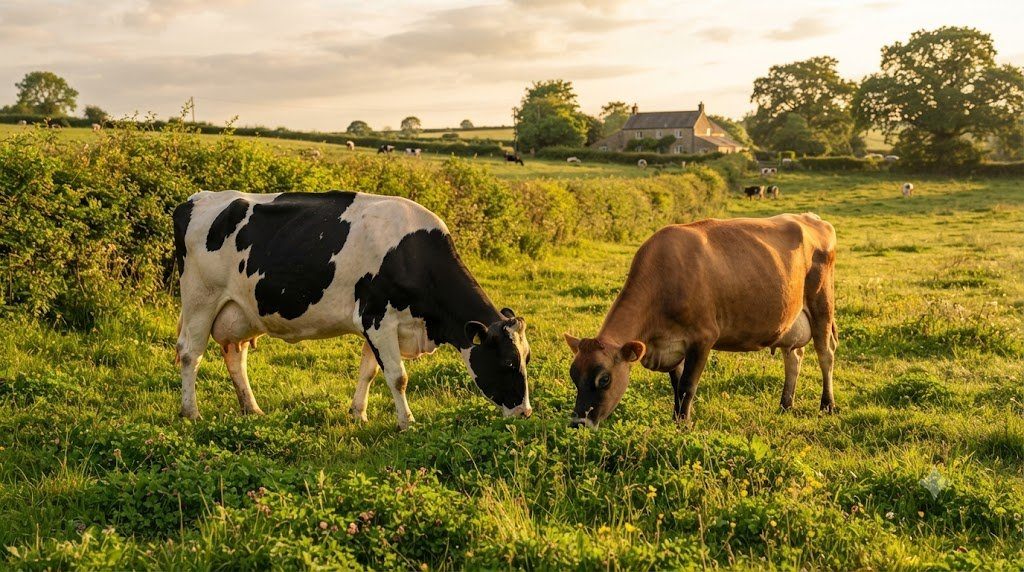
- Holstein-Friesian: Originating in the reclaimed polder marshlands of North Holland and Friesland in the Netherlands and Schleswig-Holstein in northern Germany over 2,000 years ago. Characterized by iconic black-and-white (or recessive Red-and-White) piebald markings and large angular frames, Holsteins account for over 84% of the U.S. dairy herd, unmatched in sheer fluid milk volume.
- Jersey: Developed on the British Channel Island of Jersey off the coast of Normandy, France, where strict 18th-century importation bans preserved pure island bloodlines for over two centuries. The smallest of the major dairy breeds (850 to 1,050 lbs mature weight), Jerseys display fawn-to-mahogany coats with a dark switch and muzzle, boasting the highest butterfat (4.9% to 5.4%) and protein efficiency per pound of metabolic body weight.
- Brown Swiss (Braunvieh): Considered the oldest of all documented dairy breeds, developed in the high alpine monasteries of northeastern Switzerland (Canton Schwyz). Large-framed, heavy-boned, and silver-to-dark-brown in coat color, Brown Swiss excel in longevity, hoof structural soundness, heat tolerance, and an ideal fat-to-protein ratio (1.15:1) for aged alpine cheese production.
- Guernsey: Originating on the neighboring Channel Island of Guernsey from French Froment du Léon and Norman Brindles. Known for their fawn-and-white coat and signature ‘Golden Guernsey’ milk caused by high beta-carotene concentration and high A2 beta-casein allele frequency (exceeding 92%).
- Ayrshire: Bred in the County of Ayr in southwestern Scotland during the late 1700s. Medium-framed with cherry-red and white markings, Ayrshires are renowned for grazing hardiness on rocky upland pastures, exceptionally strong median suspensory udder ligaments, and small fat globules ideal for fluid milk digestion.
Casein Polymorphisms: Beta-Casein (A1 vs A2) and Kappa-Casein (AA vs BB)
Bovine milk protein is composed of approximately 80% casein and 20% whey proteins (alpha-lactalbumin and beta-lactoglobulin). Two specific genetic loci on bovine chromosome 6 dictate milk processing and digestive properties: First, the CSN2 gene (Beta-Casein) exhibits two major alleles: A1 and A2, differing by a single amino acid at position 67 (histidine in A1 versus proline in A2). During human gastrointestinal digestion, the histidine bond in A1 milk cleaves to release beta-casomorphin-7 (BCM-7), an opioid peptide linked to digestive discomfort, whereas proline in A2/A2 milk blocks cleavage. Guernsey (92% A2), Jersey (70% A2), and Brown Swiss (75% A2) naturally carry high A2 frequencies compared to traditional Holsteins (50% A2). Second, the CSN3 gene (Kappa-Casein) features the B allele, which increases micellar stability and accelerates chymosin (rennet) clotting speed, boosting mozzarella and cheddar yield by 8% to 12%.
2. Comparative Lactation Curves and Component Benchmarks
Evaluating 305-day standardized lactation performance highlights the divergence between high-volume fluid producers and high-solids component specialists:
When evaluated on Energy-Corrected Milk (ECM) per pound of Dry Matter Intake (DMI), the Jersey cow achieves the highest carbon and feed efficiency in the dairy industry. Because a 950-pound Jersey requires 32% less maintenance energy than a 1,550-pound Holstein, a higher proportion of ingested Total Mixed Ration (TMR) energy is partitioned directly into mammary de novo fatty acid and casein synthesis.
3. Genomic Selection Indices: Net Merit (NM$) and Type Linear Traits
Modern dairy sire selection through the Council on Dairy Cattle Breeding (CDCB) relies on composite lifetime economic indices and linear conformation scoring:
The Transition Cow Hypocalcemia Hazard in Jerseys
While Jersey cows excel in butterfat and protein yield, they possess roughly 15% fewer intestinal 1,25-dihydroxyvitamin D3 receptors than Holsteins, making multiparous Jerseys significantly more susceptible to periparturient paresis (Milk Fever / clinical hypocalcemia) at calving. Close-up dry Jerseys require strict Negative Dietary Cation-Anion Difference (DCAD) rations (-100 to -150 mEq/kg DM) for 21 days pre-calving.
4. Mammary Gland Anatomy, Alveolar Secretion, and Milking Robotics
Milk synthesis occurs within microscopic secretory alveoli lined by mammary epithelial cells. Synthesizing 1 pound of fluid milk requires approximately 400 to 500 pounds of maternal blood to circulate through the internal pudendal arteries of the udder.
With the rapid adoption of Automated Milking Systems (AMS / robotic milkers), breed selection has shifted heavily toward functional udder conformation: robotic laser cameras require square teat placement, rear teats that do not cross or touch the median suspensory ligament, optimal teat length (1.8 to 2.2 inches), and moderate milking speed (6.5 to 8.5 lbs/minute) to prevent teat-cup liner slips and hyperkeratosis of the teat sphincter.
5. Nutritional Formulation: TMR Energy Density and De Novo Fatty Acids
High-producing dairy cows during peak lactation (45 to 90 days in milk) consume 48 to 62 pounds of Dry Matter Intake (DMI) per day. Rations must be precisely balanced to fuel mammary lactose, protein, and butterfat synthesis without triggering Subacute Ruminal Acidosis (SARA):
- Net Energy for Lactation ($NE_L$): Early-lactation Total Mixed Rations (TMR) are formulated at 0.76 to 0.80 Mcal/lb DM, utilizing high-digestibility brown midrib (BMR) corn silage, alfalfa haylage, steam-flaked corn, and rumen-protected palm fat (calcium salts of palmitic acid).
- Physically Effective Neutral Detergent Fiber (peNDF): Rations must maintain 28% to 32% total NDF (with at least 21% forage NDF) to stimulate cud chewing and salivary sodium bicarbonate buffering, keeping rumen pH strictly above 5.8.
- Milk Fat Depression (MFD) Prevention: Excess dietary polyunsaturated fatty acids (such as linoleic acid from distillers grains) combined with low rumen pH shifts biohydrogenation toward trans-10, cis-12 conjugated linoleic acid (CLA), which potently inhibits mammary de novo fatty acid synthesis and crashes butterfat tests below 3.0%.
6. Periparturient Metabolic Disorders and Transition Cow Management
Over 75% of infectious and metabolic diseases in commercial dairy cattle occur during the critical Transition Period (3 weeks prior to calving through 3 weeks post-calving):
- Hyperketonemia (Subclinical & Clinical Ketosis): Caused by negative energy balance (NEB) in early lactation when hepatic gluconeogenesis cannot keep pace with mammary lactose output. Excessive mobilization of non-esterified fatty acids (NEFAs) from adipose tissue overwhelms the liver, producing beta-hydroxybutyrate (BHB > 1.2 mmol/L). Managed via oral propylene glycol drenches and rumen-protected choline.
- Left Displaced Abomasum (LDA): Most prevalent in deep-bodied, angular Holsteins when post-calving rumen fill drops and hypocalcemia reduces abomasal smooth muscle motility, allowing the gas-filled abomasum to float upward along the left abdominal wall.
- Mastitis & Dry Cow Therapy: Intramammary infections by contagious (Staphylococcus aureus) or environmental (Escherichia coli, Streptococcus uberis) pathogens are prevented via selective dry cow antibiotic therapy, internal bismuth subnitrate teat sealants, and core J5 coliform vaccination.
7. Dairy Crossbreeding: ProCross and KiwiCross Systems
To overcome inbreeding depression ($F > 9\%$) in purebred Holsteins, commercial dairies increasingly utilize rotational dairy crossbreeding:
In confinement TMR parlors, the Three-Breed ProCross rotation (Holstein x VikingRed/Montbéliarde x VikingRed) or HoJo cross (Holstein x Jersey) generates 14% higher first-service conception rates, 22% lower metabolic treatment costs, and superior hoof health while maintaining competitive milk solids output. In seasonal pasture-based grazing systems, the New Zealand KiwiCross (Holstein-Friesian x Jersey) dominates due to its compact 1,050-pound frame, ability to walk long distances to parlor lanes without lameness, and strict 365-day seasonal conception efficiency.
8. Enterprise Economics, Milk Check Component Pricing, and Beef-on-Dairy
Under Federal Milk Marketing Order (FMMO) Multiple Component Pricing, dairy producers are paid directly per pound of butterfat, true protein, and other solids, with somatic cell count (SCC) quality adjustments.
Furthermore, modern dairy economics have been revolutionized by combining Sexed Dairy Semen with Beef-on-Dairy Terminal Matings. Producers breed their genetically elite top 40% heifers and cows with X-sorted sexed dairy semen (yielding 90% female replacement calves), while breeding the bottom 60% of the herd to terminal Charolais, SimAngus, or Lim-Flex beef semen. Day-old Beef-on-Dairy cross calves sell for $550 to $850 per head—generating $400+ more revenue per calf than traditional purebred dairy bull calves.
9. Frequently Asked Questions (Technical Dairy Cattle Genetics FAQ)
Q: What is the physiological difference between A1 and A2 beta-casein milk, and which breeds are highest in A2?
A1 and A2 beta-casein differ by a single amino acid at position 67 on chromosome 6: A1 contains histidine, which allows digestive enzymes to cleave off the peptide beta-casomorphin-7 (BCM-7), whereas A2 contains proline, which prevents cleavage. Guernsey cattle naturally carry a 92% to 96% frequency of the A2 allele, followed by Brown Swiss (75%) and Jersey (70%).
Q: Why is Brown Swiss and Jersey milk preferred by artisanal cheesemakers over standard Holstein milk?
Both Jersey and Brown Swiss produce higher concentrations of true protein and butterfat alongside a 55% to 80% frequency of the desirable Kappa-Casein BB genotype. The BB variant forms smaller, denser casein micelles that coagulate faster with rennet, trap more butterfat inside the curd matrix, and yield 15% to 22% more cheese per 100 pounds of milk.
Q: Why does Guernsey milk have a distinct golden-yellow color?
Guernsey cattle possess a recessive genetic variation in the beta-carotene oxygenase enzyme (BCO2), reducing the conversion of dietary beta-carotene into colorless retinol (Vitamin A) within the intestinal mucosa and liver. Consequently, intact golden beta-carotene is secreted directly into the milk fat globules.
Q: How does heat stress (Temperature-Humidity Index) differently impact Holsteins versus Jerseys and Brown Swiss?
Holsteins have a lower surface-area-to-body-mass ratio and higher internal metabolic heat of lactation, entering heat stress when the Temperature-Humidity Index (THI) exceeds 68. Jerseys and Brown Swiss possess higher sweat gland density, lighter pigmented skin/coats, and superior convective heat dissipation, maintaining stable feed intake up to a THI of 74 to 75.
Q: How does feeding a negative DCAD diet prevent Milk Fever in transition dairy cows?
Feeding anionic salts (such as ammonium chloride or calcium sulfate) creates a mild, compensated metabolic acidosis during the 21 days before calving. This slight drop in blood pH sensitizes parathyroid hormone (PTH) receptors on bone osteoclasts and kidneys, allowing the cow to rapidly mobilize skeletal calcium the moment colostrum synthesis begins.
Q: What causes Milk Fat Depression (MFD) in high-producing dairy herds?
Milk Fat Depression occurs when high-starch, low-effective-fiber rations lower rumen pH below 5.8 in the presence of unsaturated plant oils. Altered rumen bacteria produce trans-10, cis-12 conjugated linoleic acid (CLA), which travels via the bloodstream to the mammary gland and down-regulates lipogenic enzymes, slashing butterfat tests by 1.0% to 1.5%.
Q: Why has ‘Beef-on-Dairy’ breeding become a standard profit center on commercial dairies?
Using sexed X-chromosome semen on the top 40% of females provides all necessary dairy replacement heifers. Breeding the remaining 60% of dairy cows to homozygous black, muscular beef bulls (Angus, SimAngus, Lim-Flex, or Charolais) produces high-value crossbred beef calves worth $600 to $850 at one week of age, adding over $1.50/cwt to whole-farm revenue.
Q: What specific udder traits are required for cows milked in Automated Milking Systems (robotics)?
Robotic laser attachment arms require a strong median suspensory ligament (deep udder cleft), level udder floor above the hocks, perpendicular teats of medium length (2 inches), and rear teats positioned cleanly near the center of the rear quarters rather than close together.