Commercial dairy goat breeds—led by the Swiss-origin Saanen, French Alpine, Toggenburg, and Oberhasli alongside the Anglo-Nubian and American LaMancha—drive a rapidly expanding global industry for fluid caprine milk, artisanal chèvre, aged hard cheeses, and hypoallergenic infant formula. Caprine lactation physiology differs fundamentally from bovine dairy production, characterized by apocrine mammary secretion, higher medium-chain triglyceride (MCT) concentrations, naturally homogenized small fat globules, and complex polymorphisms at the Alpha-S1 Casein (CSN1S1) locus. Mastering the genetic lactation curves, seasonal photoperiod breeding manipulation, udder conformation linear appraisal, and metabolic nutrition of dairy goat breeds is essential for profitable commercial parlor management.
The Alpha-S1 Casein (CSN1S1) Polymorphism in Cheesemaking
Unlike cattle where kappa-casein dominates curd variation, caprine cheese yield is heavily governed by the CSN1S1 gene on chromosome 6, which exhibits over 18 alleles grouped into ‘Strong’ (A, B, C = 3.5 g/L per allele), ‘Intermediate’ (E = 1.1 g/L), ‘Weak’ (F = 0.45 g/L), and ‘Null’ (O = 0.0 g/L) variants. Selecting bucks homozygous for Strong CSN1S1 alleles (AA or BB) increases total milk protein by 0.4% to 0.6%, enhances rennet curd firmness by 35%, and boosts chèvre yield by 12% to 18% without altering fluid volume.
1. Historical Origins, Registry Evolution, and Caprine Breed Classifications
The American Dairy Goat Association (ADGA) and international caprine registries classify specialized dairy goats into Swiss/Alpine upright-eared lineages and Afro-Asian/Mediterranean lop-eared or gopher-eared lineages:
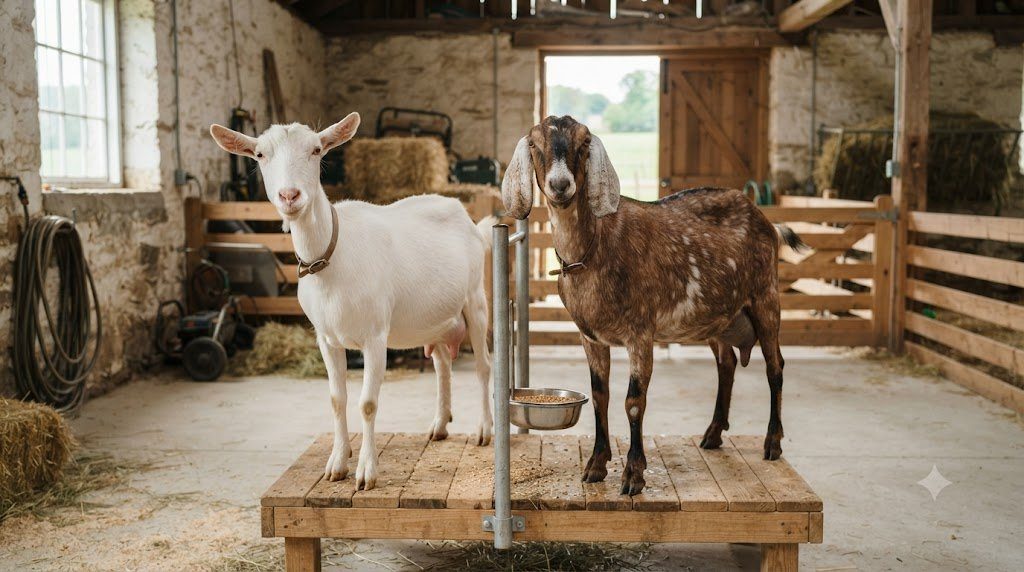
- Saanen & Sable: Originating in the Saanen Valley of the southern Canton of Bern, Switzerland. Often referred to as the ‘Holsteins of the goat world,’ purebred Saanens are large-framed (135 to 170 lbs for does) with solid white or light cream coats and erect ears. They lead all caprine breeds in 305-day fluid milk volume (2,400 to 3,200+ lbs). Sables are genetically identical purebred Saanens that do not carry the dominant white masking gene, displaying richly pigmented coat patterns that resist solar sunburn.
- French Alpine: Evolved across the French and Swiss Alps, refined in France for uniform dairy type before importation to the United States in 1922 by Dr. C.P. DeLangle. Medium-to-large framed with upright ears, straight facial profiles, and diverse color patterns (Cou Blanc, Cou Clair, Chamoisee, Sundgau, Pied). Alpines are prized for aggressive feed bunk appetite, lactational persistence, and adaptability to large commercial free-stall parlors.
- Anglo-Nubian (Nubian): Synthesized in 19th-century England by crossing native British dairy does with long-eared Zaraibi, Jamnapari, and Chitral bucks imported from Egypt, India, and the Middle East. Instantly recognizable by their strongly convex ‘Roman nose’ facial profile and long, pendulous bell-shaped ears extending at least 1 inch beyond the muzzle. Nubians produce the highest butterfat (4.6% to 5.3%) and protein (3.7% to 4.1%) among standard-sized breeds.
- American LaMancha: Developed on the West Coast of the United States during the 1920s and 1930s by Eula Frey from short-eared Spanish landrace goats originating in the La Mancha region. Defined by the dominant incomplete-penetrance ear mutation yielding either ‘Gopher Ears’ (maximum 1 inch, zero cartilage, required for buck registration) or ‘Elf Ears’ (maximum 2 inches, slight cartilage allowed in does). Known for exceptionally calm parlor temperament and high milk solids.
- Toggenburg & Oberhasli: Toggenburgs (from the Toggenburg Valley of St. Gallen, Switzerland) are the oldest registered dairy goat breed, fawn-to-chocolate brown with crisp white facial stripes and white lower legs, renowned for cool-weather milk persistence and long productive life. Oberhaslis (from the Bernese Oberland) display striking rich bay ‘chamoisee’ coats with black dorsal stripes and facial markings.
2. Comparative 305-Day Lactation Metrics and Milk Solids Composition
Standardized ADGA Dairy Herd Improvement Registry (DHIR) 305-day lactation records demonstrate distinct volume versus component trade-offs across the major dairy goat breeds:
While Saanens and Alpines dominate high-volume fluid milk contracts, artisanal farmstead creameries frequently maintain mixed herds (such as 60% Alpine/Saanen blended with 40% Nubian/LaMancha—or Nigerian Dwarf miniature dairy goats testing at 6.5% butterfat) to balance spring-to-autumn volume with rich winter cheese solids.
3. Caprine Mammary Secretion, Fat Globule Biochemistry, and Flavor Control
Caprine milk exhibits unique biochemical and physical attributes compared to bovine milk:
- Apocrine vs. Merocrine Secretion: Unlike cows (which utilize merocrine secretion), goat mammary epithelial cells utilize apocrine secretion, pinching off tiny cytoplasmic fragments and non-pathogenic epithelial cells directly into the milk. Consequently, healthy, mastitis-free goat milk naturally exhibits higher baseline Somatic Cell Counts (SCC of 350,000 to 800,000 cells/mL, particularly in late lactation). Regulatory Grade A standards therefore set the caprine SCC legal limit at 1,500,000 cells/mL (versus 750,000 for cows), requiring the use of pyronin-Y methyl green DNA staining rather than standard bovine counters to distinguish cytoplasmic particles from true leukocytes.
- Medium-Chain Triglycerides (MCTs) & Natural Homogenization: Goat milk fat globules average 2.0 to 2.5 micrometers in diameter (versus 3.5 to 4.5 micrometers in cow milk) and completely lack the protein agglutinin, meaning goat milk does not rapidly separate a cream line when chilled. Furthermore, caprine butterfat contains 30% to 35% medium-chain fatty acids—specifically Caproic (C6:0), Caprylic (C8:0), and Capric (C10:0) acids—which are absorbed directly into the portal vein for rapid human digestion.
- Preventing Lipolysis & ‘Goaty’ Off-Flavors: Clean, rapidly cooled goat milk is sweet and indistinguishable from cow milk. The pungent ‘goaty’ flavor in poorly handled milk is caused by endogenous lipoprotein lipase enzymes hydrolyzing short-chain fatty acids (especially 4-ethyloctanoic acid) when warm milk is agitated in pipeline risers or when late-lactation does experience estrus spikes.
4. ADGA Linear Appraisal, Udder Attachment, and Parlor Conformation
In commercial rotary and herringbone parlors, doe longevity depends on structural mammary soundness evaluated through the ADGA Linear Appraisal System (scored on a 50-to-99 point scale across General Appearance, Dairy Character, Body Capacity, and Mammary System):
The Polled Intersex Syndrome (PIS) Genetic Warning
In Swiss and European dairy goat breeds, the dominant Polled (hornless) allele (P) on chromosome 1 is tightly linked to a 11.7-kb deletion that causes Polled Intersex Syndrome (PIS). Homozygous polled females (P/P) suffer sex-reversal during embryonic gonadogenesis, developing into sterile hermaphrodites/pseudohermaphrodites, while homozygous polled bucks often develop epididymal sperm granulomas. Never mate two naturally polled dairy goats together; always mate a polled animal (P/p) to a horned/disbudded partner (p/p) to completely avoid sterile intersex kids.
5. Photoperiod Manipulation and Out-of-Season Breeding Protocols
Swiss dairy breeds (Saanen, Alpine, Toggenburg, Oberhasli) are strictly short-day seasonal polyestrous breeders. As autumn daylight decreases below 12 hours, retinal photoreceptors signal the pineal gland to extend nocturnal melatonin secretion, which stimulates hypothalamic Gonadotropin-Releasing Hormone (GnRH) pulsatility and initiates estrus cycles every 21 days from September through January. Left unmanaged, 100% of the herd kids in spring and dries off in winter, starving cheese plants of winter milk.
Commercial dairies achieve year-round milk flow through artificial Photoperiod Light-Treatment Programs: Beginning in mid-winter (January), a breeding group of does and bucks is exposed to 20 hours of artificial high-intensity light (minimum 200 lux at eye level) for 60 consecutive days to mimic long summer days. In March, lights are abruptly turned off (returning to natural spring day length) or melatonin implants are administered, tricking the pineal gland into perceiving autumn. Combined with the ‘Buck Effect’ (introducing a pheromonal light-treated buck after 60 days of total separation), 80% to 90% of does conceive in April/May for autumn kidding and high-priced winter lactation.
6. High-Energy Lactation Nutrition, Browse Mechanics, and Pregnancy Toxemia
High-yielding dairy does are metabolic athletes capable of consuming 4.0% to 5.5% of their body weight in Dry Matter Intake (DMI) daily—nearly double the relative intake rate of a dairy cow:
- Peak Lactation Ration Formulation: A 150-pound Saanen or Alpine doe producing 12 lbs (1.4 gallons) of milk daily requires 6.5 to 8.0 lbs of DMI supplying 16% to 17% crude protein and 0.78 Mcal/lb $NE_L$. Rations combine leafy second-cutting alfalfa hay (rich in calcium and rumen-buffering pectin) with a 16% pelleted dairy grain concentrate containing steam-flaked corn, soybean meal, beet pulp, and 0.8% sodium bicarbonate.
- Late-Gestation Pregnancy Toxemia (Ketosis) Prevention: Because dairy goats frequently carry twins, triplets, or quadruplets during their 150-day gestation, 70% of fetal growth occurs during the final 6 weeks. Rapidly expanding fetuses compress rumen volume while demanding massive maternal glucose. If dietary energy density drops during late gestation, the doe mobilizes body fat rapidly, triggering fatal hepatic lipidosis and ketoacidosis (Pregnancy Toxemia). Late-gestation rations must increase grain energy density to 0.5 to 1.0 lb/day alongside high-digestibility forage.
- Urolithiasis Prevention in Breeding Bucks: Breeding bucks must never be fed high-phosphorus lactating doe grain rations without balanced calcium. Maintain a strict 2:1 to 2.5:1 Calcium-to-Phosphorus ratio and incorporate 0.5% to 1.0% ammonium chloride to acidify urine and prevent fatal obstructive struvite or apatite urinary calculi.
7. Veterinary Health: CAE, CL, Johne’s Disease, and Mycoplasma Biosecurity
Commercial dairy goat profitability depends on maintaining a closed, biosecure herd free from the ‘Big Four’ chronic caprine pathogens:
- Caprine Arthritis Encephalitis (CAE): A retroviral lentivirus transmitted primarily from infected does to neonatal kids via colostrum and milk. Causes crippling carpal/hock joint arthritis (‘big knee’) in adult does, indurative ‘hard bag’ mastitis that ruins milk yield, and leukoencephalomyelitis paralysis in kids. Eradicated via annual serum ELISA testing and strict CAE-Prevention Kid Snatching: removing kids immediately at birth, feeding colostrum heat-treated at 135°F (56°C) for 60 minutes, and raising kids on pasteurized milk or milk replacer.
- Caseous Lymphadenitis (CL – Corynebacterium pseudotuberculosis): Causes encapsulated purulent abscesses in external parotid/submandibular lymph nodes and internal lungs/liver. Prevented via strict quarantine, serologic Synergistic Hemolysis Inhibition (SHI) testing, and never introducing abscessed animals into the parlor.
- Johne’s Disease (Mycobacterium avium subsp. paratuberculosis): Causes chronic, untreatable granulomatous enteritis, progressive weight wasting despite a normal appetite, and eventual death. Monitored via annual fecal PCR and serum ELISA screening.
8. Enterprise Economics, Parlor Throughput, and Artisanal Cheese Margins
Commercial fluid goat milk commands wholesale prices of $42 to $58 per hundredweight (cwt)—more than double the price of commodity bovine milk. A well-managed commercial doe producing 2,600 pounds of milk per lactation generates $1,100 to $1,500 in gross milk revenue against annual feed and operating costs of $480 to $620 per doe.
For farmstead vertical processors converting raw milk into fresh chèvre, feta, or aged gouda (achieving a 12% to 16% cheese yield selling at $16 to $28 per pound retail), gross value-added revenue surges to $3,500 to $5,200 per lactating doe annually.
9. Frequently Asked Questions (Technical Dairy Goat Genetics FAQ)
Q: Why does Alpha-S1 Casein (CSN1S1) genotype matter so much when selecting dairy goat bucks?
The CSN1S1 gene exhibits dramatic polymorphism in goats. Bucks carrying two copies of ‘Strong’ alleles (A or B) sire daughters that synthesize 3.5 grams per liter of alpha-s1 casein per allele, compared to 0.45 g/L for ‘Weak’ (F) alleles. Strong-allele milk forms denser, firmer curds with significantly less fat lost in the whey, increasing cheese yield by up to 18%.
Q: What is the genetic difference between gopher ears and elf ears in American LaMancha goats?
Gopher ears have a maximum length of 1 inch with zero or virtually zero internal cartilage, turning up or down at the tip. Elf ears can be up to 2 inches long with a small amount of cartilage shaping the small ear flap. Under ADGA registry rules, a purebred LaMancha buck must have true gopher ears to be eligible for registration.
Q: Why is it dangerous to breed two naturally polled (hornless) dairy goats together?
In European dairy goats, the dominant Polled gene (P) is genetically linked to Polled Intersex Syndrome (PIS). Mating two heterozygous polled goats (P/p x P/p) results in 25% homozygous polled (P/P) offspring; 100% of XX females with the P/P genotype undergo fetal masculinization into sterile intersex hermaphrodites.
Q: Why do healthy dairy goats naturally have much higher Somatic Cell Counts (SCC) than dairy cows?
Unlike cows that secrete milk via merocrine secretion, goats utilize apocrine mammary secretion, which naturally sheds non-nucleated cytoplasmic droplets (christie-wooding bodies) into the milk alongside normal epithelial turnover. These droplets are roughly the same size as white blood cells, fooling standard bovine automated cell counters unless DNA-specific stains are used.
Q: What causes goat milk to develop a strong, musky ‘goaty’ taste, and how is it prevented?
Fresh, properly handled goat milk is sweet and mild. Off-flavors develop when warm milk is violently agitated in vacuum lines or cooled too slowly, allowing lipoprotein lipase enzymes to break down milk fat triglycerides into free volatile branched-chain fatty acids (caproic, caprylic, and 4-ethyloctanoic acid). Immediate chilling to 38°F within 1 hour of milking prevents lipolysis.
Q: How do commercial goat dairies heat-treat colostrum to eradicate Caprine Arthritis Encephalitis (CAE)?
Because temperatures above 140°F coagulate immunoglobulins (IgG) into a solid pudding, colostrum must be heated in a precision water-bath pasteurizer strictly between 133°F and 135°F (56°C to 57°C) for 60 continuous minutes. This thermal threshold inactivates the CAE lentivirus while preserving over 85% of maternal IgG antibodies.
Q: Why are Anglo-Nubian and Nigerian Dwarf goats able to breed out of season more easily than Saanens?
Saanens and Alpines evolved at high latitudes in the Swiss Alps (46°N), where survival required strict autumn breeding for spring kidding. Anglo-Nubians and Nigerian Dwarfs carry equatorial/subtropical African and Indian genetic ancestry where day length fluctuates minimally year-round, reducing pineal melatonin sensitivity and enabling extended or year-round estrus cycling.
Q: How do producers prevent Pregnancy Toxemia (Ketosis) in high-producing does carrying triplets?
During the last 45 days of gestation, producers separate multiple-bearing does (identified via transabdominal ultrasound at day 50) and feed high-digestibility leafy alfalfa alongside 0.75 to 1.25 lbs of energy-dense grain daily, keeping doe Body Condition Score at 3.0 to 3.25 without letting them become overly obese (BCS > 4.0) earlier in the dry period.