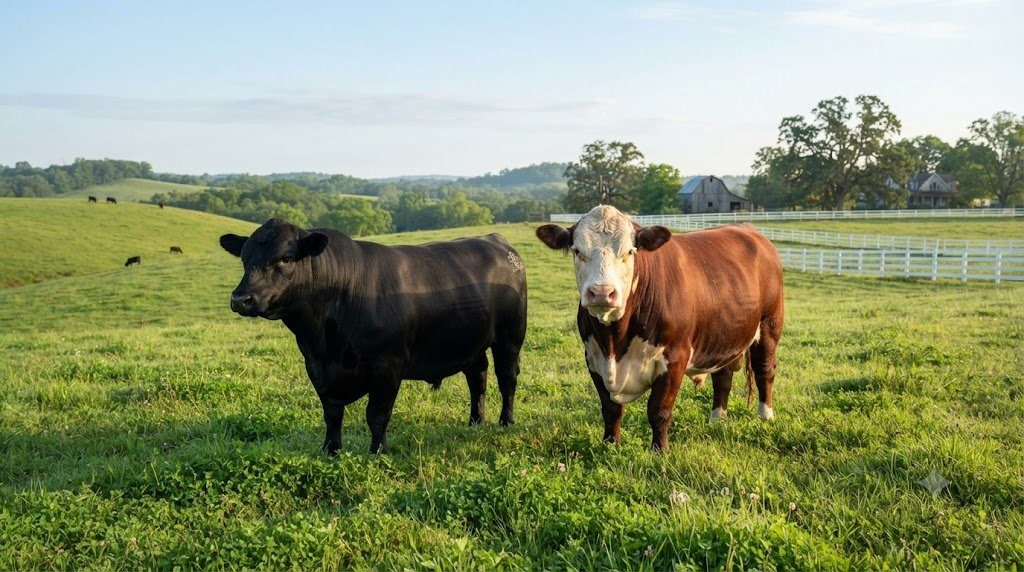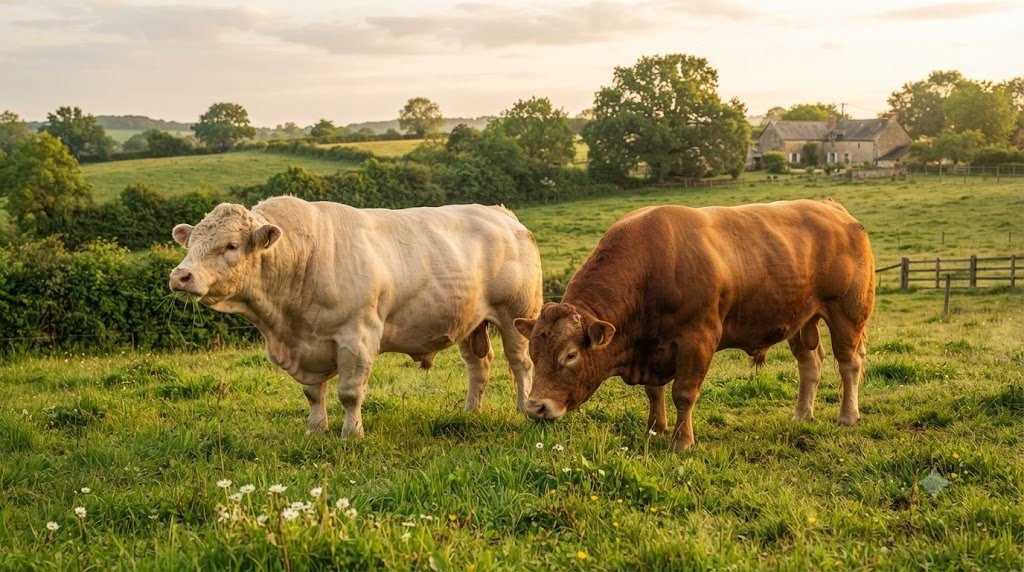
Continental European beef cattle breeds—led by Charolais, Simmental, Limousin, and Gelbvieh—represent the high-octane terminal growth and lean red-meat yield engines of modern beef production. Originating in the agricultural valleys and alpine plateaus of France, Switzerland, and Germany, these large-framed Bos taurus breeds were historically selected as triple-purpose draft, meat, and milk animals before undergoing intensive 20th-century specialization for rapid post-weaning skeletal growth, superior feed conversion efficiency, large ribeye area (longissimus dorsi), and exceptional retail cutability (USDA Yield Grades 1 and 2). Understanding the myostatin genetics, metabolic energetics, and hybrid terminal crossbreeding mechanics of Continental breeds is essential for maximizing carcass weight and feedlot profitability.
The Terminal Crossbreeding Powerhouse
Mating Continental terminal sires (such as Charolais or Simmental) to moderate-framed British crossbred cows (such as Angus x Hereford F1 females) captures maximum terminal heterosis: weaning weights surge by 45 to 70 pounds per calf, feedlot average daily gain (ADG) increases by 12% to 16%, and carcass red-meat yield rises by 3% to 5% without increasing maternal cow maintenance costs.
1. Historical Origins, European Selection, and Breed Transformations
Unlike British breeds that were selected early for pasture fattening, Continental cattle evolved as heavy, muscular working and multi-purpose animals across continental Europe, shaping their dense bone structure and lean muscle hypertrophy:
- Charolais: Originating in the Charolles and Nièvre districts of east-central France, this creamy-white to wheaten breed was developed for draft power and heavy beef carcass weight. Imported into North America via Mexico in the 1930s and 1960s, the Charolais remains the premier terminal sire breed worldwide for rapid post-weaning growth and heavy carcass weight.
- Simmental (Fleckvieh): Developed in the Simme Valley of the Bernese Oberland in western Switzerland, dating back to the Middle Ages. Originally a red-and-white dual-purpose milk and beef breed, North American breeders transformed the Simmental through introgression of homozygous black and polled genetics into an adaptable maternal-terminal powerhouse (particularly via SimAngus composites).
- Limousin: Native to the mineral-poor, acidic granite hills of the Limousin and Marche regions in south-central France. Selected for extreme muscularity, fine bone density, and high dressing percentage, the golden-red (and modern black/polled) Limousin excels in retail meat-to-bone ratio and feed conversion efficiency.
- Gelbvieh: Created in three Franconian districts of Bavaria, Germany, in the late 18th and 19th centuries from local red-yellow landrace strains. Prized for early sexual puberty, high maternal milk output, quiet disposition, and adaptability in crossbreeding programs (such as the Balancer hybrid).
Myostatin (GDF8) Polymorphisms and Muscle Hypertrophy
A defining genetic hallmark of Continental cattle—particularly Limousin, Charolais, and Belgian Blue/Piedmontese lineages—is the prevalence of functional polymorphisms in the Myostatin gene (MSTN / GDF8) located on bovine chromosome 2. Myostatin acts as a negative regulator of skeletal muscle growth during embryonic myogenesis. Specifically, the F94L missense mutation found at high frequency in Limousin and Charolais cattle causes a partial loss of myostatin inhibition without triggering extreme double-muscling dystocia. Cattle carrying one or two copies of the F94L allele exhibit a 7% to 15% increase in muscle fiber number (hyperplasia), a 10% larger ribeye cross-sectional area, and significantly higher retail meat yield with minimal impact on calving ease.
2. Comparative Phenotypic Metrics and Carcass Cutability
Evaluating the four major Continental breeds highlights distinct trade-offs between mature skeletal frame, maternal lactation output, and carcass lean-to-fat ratios:
Limousin steers consistently record the highest carcass dressing percentages (often exceeding 65.5%) and the largest ribeye area per hundredweight of carcass due to their fine skeletal bone density and F94L myostatin frequency. Conversely, Simmental and Gelbvieh females retain superior maternal milk output and earlier age at first puberty (320 to 350 days), making them highly suited for composite maternal foundation herds.
3. Coat Color Dilution (PMEL) and Composite Hybrid Registries
In Charolais cattle, the signature creamy-white coat is governed by a dominant mutation at the Premelanosomal Protein (PMEL / Silver Dilution) locus on chromosome 5 ($Dc/Dc$). When a homozygous white Charolais bull ($Dc/Dc$) is bred to a homozygous Black Angus cow ($E^D/E^D, dc/dc$), 100% of the F1 terminal calves inherit one dilution allele ($Dc/dc$) over a dominant black base, producing a uniform silver-buckskin or smoky-grey coat. In feeder cattle auctions across the Great Plains, pens of ‘Smoky’ Charolais-Angus cross steers command top-of-the-market prices due to their unmistakable visual proof of terminal hybrid vigor.
To streamline crossbreeding for commercial ranchers without managing multi-pasture rotations, Continental breed associations established official composite registries combining Continental muscle with British marbling and calving ease:
4. Feedlot Energetics, Protein Accretion Curves, and Carcass Endpoints
Continental cattle possess a fundamentally different physiological growth curve compared to British cattle. Because their mature skeletal and muscular size is larger, Continental steers remain in the linear phase of lean protein accretion up to 1,450 to 1,600 pounds live weight:
Dietary Crude Protein and Metabolizable Amino Acid Demands
Because Continental steers deposit lean skeletal muscle protein at rates exceeding 0.65 lbs of pure protein per day during peak feedlot growth, finishing rations must supply higher Metabolizable Protein (MP) and rumen-undegradable protein (RUP / bypass protein) than standard British rations. Rations deficient in lysine and methionine restrict muscle hypertrophy and depress feed efficiency.
While British steers must be harvested around 1,350 pounds to avoid excessive backfat, Continental and Continental-cross steers can be fed to heavy carcass weights (950 to 1,050 lbs hot carcass weight) while maintaining 0.30 to 0.45 inches of 12th-rib fat thickness. This dilution of fixed packer processing costs per pound of boxed beef makes Continental crosses highly lucrative in heavy-carcass feedyard regimes.
5. Calving Ease Management, Pelvic Morphometry, and Dystocia Prevention
During the initial importation boom of Continental cattle in the 1970s, indiscriminate breeding of massive-framed European bulls to young heifers resulted in elevated dystocia (calving difficulty) due to heavy birth weights (95 to 115 lbs) and broad fetal shoulder width. Over the past 30 years, intensive selection for Calving Ease Direct (CED) and lower Birth Weight (BW) EPDs has transformed modern Continental bloodlines:
- Mature Cow Terminal Mating Only: Purebred Charolais and fullblood Simmental terminal bulls should be mated strictly to multiparous mature cows (second calf and older) possessing pelvic areas exceeding 210 square centimeters.
- Curve-Bender Composite Bulls for Heifers: When breeding yearling heifers, producers select ‘curve-bender’ SimAngus, Balancer, or Lim-Flex bulls ranked in the top 10% for CED and negative Birth Weight EPD, which produce 74-lb calves at birth that still explode to 680+ lbs at weaning.
- Gestation Length (GL) EPD Selection: Continental breeds naturally exhibit slightly longer gestation lengths (285 to 289 days) compared to Angus (281 days). Selecting bulls with negative Gestation Length EPDs (-2 to -5 days) reduces fetal birth weight by 1.2 pounds for every day gestation is shortened.
6. Nutritional Management of High-Producing Continental Brood Cows
Continental maternal breeds (Simmental and Gelbvieh) possess larger visceral organ mass (liver and gastrointestinal tract) and higher peak lactation output (24 to 30 lbs of milk per day) than British cows. Consequently, their maintenance energy requirement ($NE_m$) is 10% to 14% higher per unit of metabolic body weight:
To maintain a 365-day calving interval, Simmental- and Gelbvieh-cross cows must calve at a minimum Body Condition Score (BCS) of 5.5 to 6.0 (on a 1-to-9 scale). During the 80-day post-partum window prior to breeding, rations must supply at least 64% Total Digestible Nutrients (TDN) and 11.5% crude protein, supplemented with chelated trace minerals (copper, zinc, manganese, and selenium) to support rapid uterine involution and strong estrus cyclicity.
7. Veterinary Health, Hoof Integrity, and Congenital Screening
Health protocols in Continental breeding programs emphasize structural soundness and genetic screening:
- Hoof Pigmentation & Structural Claw Angle: Because heavy-muscled bulls place substantial biomechanical load on the phalangeal joints, selecting for dark, dense hoof horn and optimal 45- to 50-degree pastern angles prevents screw-claw deformities and interdigital necrobacillosis (foot rot).
- Protoporphyria & Diluter Screening: Limousin breeders test for Bovine Erythropoietic Protoporphyria (Proto), a recessive photosensitivity disorder. Simmental breeders screen against the recessive ‘Diluter’ gene when mating to Black Angus to prevent undesirable rat-tail hair dysplasia.
- Bovine Respiratory Disease (BRD) Preconditioning: High-growth Continental cross calves experience rapid maternal antibody decay around 120 days of age. A strict 45-day weaning preconditioning protocol (VAC-45) with modified-live viral vaccines (IBR, BVD Types 1 & 2, PI3, BRSV) and Mannheimia haemolytica leukotoxoid is mandatory before feedyard entry.
8. Enterprise Economics, Feed Conversion, and Grid Marketing
In commercial cattle feeding, Feed-to-Gain (F:G) conversion ratio is the primary determinant of cost of gain. Continental and F1 Continental-British cross steers convert dry matter into live weight gain at 5.2:1 to 5.7:1, compared to 6.1:1 to 6.6:1 for late-stage purebred British steers depositing fat.
On muscle-rewarding packer grids, Continental cross carcasses capture $4 to $10/cwt premiums for USDA Yield Grade 1 and 2 cutability while avoiding the -$15 to -$25/cwt discounts levied on over-fat Yield Grade 4 carcasses. Combined with an extra 60 to 90 pounds of hot carcass weight per animal, terminal Continental crossbreeding adds $110 to $190 per head in net enterprise return.
9. Frequently Asked Questions (Technical Continental Cattle Genetics FAQ)
Q: How does the F94L myostatin gene variant in Limousin and Charolais cattle differ from extreme double-muscling mutations?
Unlike the null nt821 deletion in Belgian Blue cattle that completely deactivates myostatin and requires cesarean delivery, the F94L polymorphism is a conservative amino acid substitution that moderately reduces myostatin activity. It increases muscle mass and ribeye area by 8% to 15% and improves tenderness without causing severe birth weight spikes or calving paralysis.
Q: Why do Charolais bulls crossed on Black Angus cows produce uniform silver or smoky-grey calves?
Purebred Charolais are homozygous for the dominant Premelanosomal Protein (PMEL) dilution gene (Dc/Dc), which dilutes pigment production in hair follicles. When crossed on Black Angus (ED/ED), the dominant black base pigment is partially diluted by the heterozygous Dc/dc genotype, yielding a uniform silver-grey or smoky buckskin coat.
Q: What is the difference between traditional Fleckvieh Simmental and modern North American Black Simmental?
Traditional European Fleckvieh are horned, red-and-white spotted dual-purpose cattle with massive bone structure and high dairy milk production. Modern North American Simmentals have been selectively bred (often incorporating Angus black/polled alleles) for solid coat color, polled heads, smoother shoulder conformation for calving ease, and enhanced intramuscular marbling.
Q: Why do Continental cattle achieve superior feed conversion efficiency (F:G) in the feedlot?
Synthesizing lean skeletal muscle tissue requires far less dietary caloric energy per pound of wet weight gain than synthesizing adipose fat tissue, because lean muscle is approximately 72% water and 22% protein, whereas adipose tissue is over 85% energy-dense lipid. Because Continental cattle remain in lean muscle growth longer, they gain more weight per pound of dry matter consumed.
Q: What is a Balancer hybrid, and what is its optimal role in a commercial beef herd?
A Balancer is a registered composite combining 25% to 75% Gelbvieh with 25% to 75% Angus or Red Angus. Balancers are engineered specifically as maternal replacement females and multi-purpose bulls, combining Gelbvieh early puberty, milk flow, and stayability with Angus calving ease and carcass marbling.
Q: How does Gestation Length (GL) EPD affect birth weight in Continental crossbred calves?
During the final two weeks of bovine gestation, the fetus gains approximately 1.0 to 1.5 pounds per day in utero. Selecting Continental bulls with a -4 day Gestation Length EPD causes cows to calve four days earlier, reducing calf birth weight by 4 to 6 pounds and substantially improving unassisted calving ease.
Q: Why are Continental cows less suited to desert rangelands than British or Bos indicus crosses?
Continental maternal breeds like Simmental and Gelbvieh have larger internal organ weights (liver and GI tract) and higher genetic milk potential, which elevate their baseline maintenance energy requirements even when non-lactating. In sparse desert environments (< 12 inches rainfall), they struggle to maintain body condition without supplemental protein feeding.
Q: How do commercial producers capture both Yield Grade 1-2 muscle and USDA Choice/Prime marbling?
By utilizing a 50:50 composite F1 cross (such as SimAngus, Lim-Flex, or Charolais x Angus) and administering an estrogenic/trenbolone acetate growth implant paired with a high-starch finishing ration for 140 days, producers achieve the ideal biological balance: 85%+ USDA Choice/Prime quality grades alongside 75%+ Yield Grade 1 and 2 cutability.