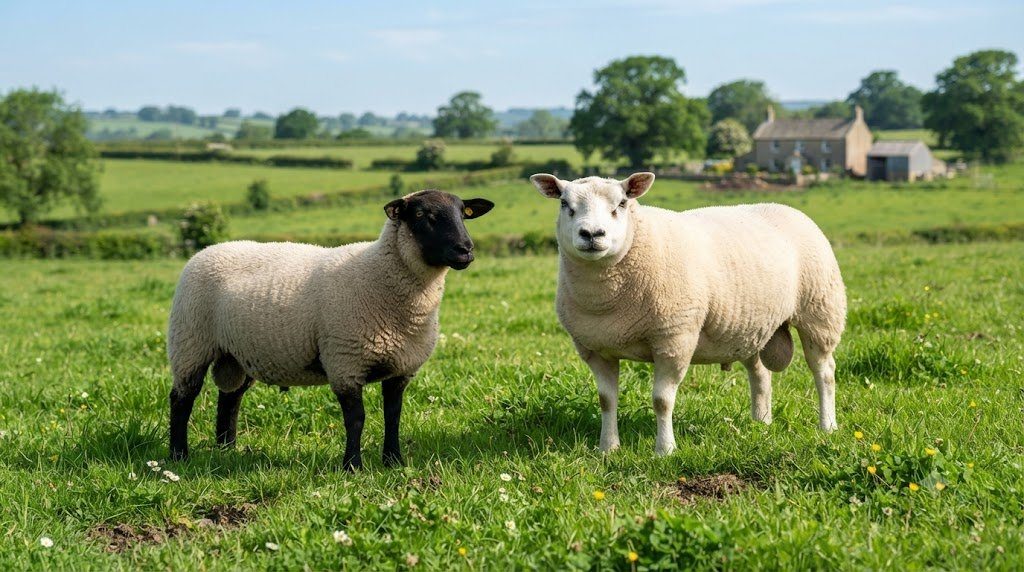
Terminal meat sire and British/Continental Down sheep breeds—led by the Suffolk, Hampshire, Dutch Texel, Polled Dorset, Shropshire, and Southdown—serve as the primary muscular growth and carcass-conformation drivers of the global lamb industry. When terminal rams are crossed onto prolific maternal white-faced or hair ewes, their hybrid offspring exhibit explosive post-weaning Average Daily Gain (ADG exceeding 0.85 to 1.15 lbs/day), superior feed conversion efficiency, expansive loin eye area (longissimus dorsi cross-section > 3.2 square inches), and high retail leg-and-loin primal yield. Mastering the myostatin 3′-UTR regulatory genetics of the Texel, the codon 171 prion scrapie resistance genotypes, and the out-of-season aseasonal breeding genetics of the Dorset is essential for profitable commercial lamb production.
The Texel Myostatin (GDF8 g+6723G>A) MicroRNA Mechanism
The Dutch and British Texel breed exhibits extreme muscular hypertrophy across the leg and loin without carrying a coding mutation in the Myostatin protein itself. Instead, Texel sheep carry a unique G-to-A transition mutation (g+6723G>A) in the 3′-untranslated region (3′-UTR) of the GDF8 gene, which creates an illegitimate target site for muscle-specific microRNAs (miR-1 and miR-206). These microRNAs block myostatin translation, reducing circulating myostatin by 65% and increasing carcass lean meat yield by 8% to 12% without causing extreme calving/lambing dystocia.
1. Historical Origins, Downland Evolution, and Terminal Sire Taxonomies
Most classic terminal meat breeds originated in the chalk hills (‘Downs’) of southern England or the coastal islands of the North Sea, bred specifically to convert lush clover, turnips, and rotational arable pastures into prime butcher lambs:
- Suffolk: Developed in the late 1700s in Norfolk and Suffolk, England, by crossing horned black-faced Norfolk Horn ewes with compact Southdown rams (officially recognized in 1810). Distinguished by a jet-black, completely woolless head and legs, Roman nose, bell-shaped black ears, and a massive, long-bodied skeletal frame. The Suffolk is the #1 terminal sire breed in North America, unrivaled in post-weaning growth rate and lean carcass weight.
- Hampshire: Originating in the Hampshire Downs of southern England in the early 1800s from crosses of Wiltshire Horn, Berkshire Knot, and Southdown bloodlines. Large-framed and heavy-boned with a dark brown-to-black face, woolless black ears, and a characteristic wool cap extending over the poll and forehead alongside wool on the lower legs. Hampshires mature slightly earlier than Suffolks, finishing well on grass-plus-grain diets with thick loin muscling.
- Texel: Originating on the island of Texel off the coast of North Holland in the Netherlands, upgraded in the mid-19th century with Lincoln and Leicester blood before intense selection for extreme muscle conformation. Clean white face and legs with a black nose and dark hooves, zero wool on the head or below the knees/hocks, and massive convex stifle and loin thickness driven by the GDF8 3′-UTR allele.
- Dorset (Polled & Horned): Native to Dorset and Somerset in southwestern England. Medium-to-large white-faced breed (Polled Dorset mutation discovered at North Carolina State University in 1948). Famous as the premier dual maternal-terminal white-faced breed capable of true out-of-season (spring/summer) breeding for lucrative autumn-born ‘hothouse’ and Christmas holiday lambs.
- Shropshire & Southdown: The Southdown (from the Sussex Hills) is the oldest of all British terminal breeds and the progenitor of every other Down breed; moderate-framed with mouse-brown face/legs and extreme meat-to-bone carcass thickness. The Shropshire (from Shropshire and Staffordshire) is a medium-sized, docile, dark-faced farm-flock breed increasingly utilized for weed-grazing in Christmas tree plantations and orchards because it rarely strips bark.
2. Comparative Terminal Sire Growth and Carcass Metrics
Comparing the five major meat breeds highlights the strategic balance between frame growth (Suffolk) and extreme muscularity/dressing percentage (Texel and Southdown):
In commercial terminal crossbreeding, many producers utilize F1 Texel x Suffolk (‘Tex-Suff’) or Hampshire x Suffolk (‘Hamp-Suff’) composite terminal rams. A Texel x Suffolk crossbred ram delivers both the long skeletal frame and 1.1-lb/day post-weaning gain of the Suffolk and the bulging leg conformation and 55%+ dressing percentage of the Texel.
3. Prion Protein (PRNP) Scrapie Genetics and Codon 171 Selection
Historically, black-faced Down breeds (particularly Suffolks and Hampshires) exhibited higher susceptibility to Scrapie, a fatal, transmissible spongiform encephalopathy (TSE) caused by misfolded prion proteins ($PrP^{Sc}$). Veterinary geneticists discovered that genetic susceptibility to classical scrapie is controlled by amino acid polymorphisms at Codons 136, 154, and 171 of the Ovine Prion Protein gene (PRNP):
The Callipyge (‘Beautiful Buttocks’) Polar Overdominance Paradox
Discovered in a Dorset ram named Solid Gold in Oklahoma in 1983, the Callipyge (CLPG) mutation on chromosome 18 causes a 30% increase in pelvic and hind-limb muscle mass with minimal fat. However, CLPG exhibits unique ‘polar overdominance’ genomic imprinting: only heterozygous lambs that inherit the CLPG allele from their sire and a normal allele from their dam (+Mat / CLPGPat) express extreme muscling. Even more critically, the Callipyge gene causes a 400% surge in muscle Calpastatin activity, rendering the loin meat unacceptably tough unless electrically stimulated or chemically tenderized. Consequently, commercial breeders prefer the Texel GDF8 allele or NSIP terminal carcass indexes over Callipyge.
4. Out-of-Season Accelerated Lambing with Polled Dorset Genetics
Because most British Down breeds (Suffolk, Hampshire, Shropshire) evolved at high northern latitudes (51°N to 55°N), they experience deep seasonal anestrus from March through July, forcing all lambs to be born in spring and marketed in early autumn when prices are lowest.
The Polled Dorset (alongside the Horned Dorset) carries a high frequency of the Melatonin Receptor 1A (MTNR1A) polymorphism on chromosome 26, which desensitizes the hypothalamus to long spring daylight. By maintaining a maternal flock of Dorset or Dorset-Rambouillet-Finnsheep cross ewes, producers can implement the Cornell STAR Accelerated Lambing System—dividing the year into five 73-day intervals where ewes lamb every 8 months (producing 5 lambings in 3 years), hitting peak winter and early spring lamb market prices.
5. Ultrasound Carcass Scanning and NSIP Terminal Carcass Index
In modern pedigree Suffolk, Hampshire, and Texel flocks, visual show-ring appraisal is supplemented by real-time B-Mode Ultrasound Scanning at 120 to 150 days of age across the 12th and 13th ribs to measure Eye Muscle Depth (EMD) in millimeters and Backfat Thickness (FAT).
These ultrasound metrics feed directly into the NSIP Carcass Plus Index, which weights Post-Weaning Weight (+60%), Eye Muscle Depth (+25%), and negative Fat Depth (-15%). Selecting a terminal sire scoring above 160 on the Carcass Plus Index guarantees lambs that reach a 140-pound slaughter weight 18 days faster than breed average while yielding an extra 3.5 pounds of high-value boneless loin and leg cuts.
6. Feedlot Finishing Nutrition, Creep Feeding, and Acidosis Control
To unlock the genetic growth ceiling of terminal-sired crossbred lambs (1.0+ lb/day ADG), nutritional management must transition smoothly from nursing to high-energy finishing:
- Early Creep Feeding (Day 10 to Weaning at Day 60): Because a ewe’s lactation curve peaks at 21 to 28 days post-lambing and declines rapidly thereafter, lambs nursing twins or triplets require access to a palatable 18% to 20% Crude Protein Soybean Meal / Cracked Corn Creep Ration starting at 10 days of age to stimulate rumen papillae development via butyrate and propionate fermentation.
- High-Concentrate Feedlot Finishing (60 to 140 lbs): Finishing rations consist of 75% to 85% whole shelled corn (sheep chew whole grain thoroughly, preventing rapid starch fermentation and acidosis compared to finely ground meal) blended with 15% to 25% pelleted protein-vitamin-mineral supplement containing Lasalocid (Bovatec) for coccidiosis prevention, 0.5% to 1.0% Ammonium Chloride to prevent urinary calculi, and a strict 2.5:1 Calcium-to-Phosphorus ratio.
- Preventing Enterotoxemia Type D (Overeating Disease): Rapidly growing lambs on high-grain diets are extremely vulnerable to Clostridium perfringens Type D epsilon toxin. Lambs must receive an initial CD-T toxoid vaccination at 3 to 4 weeks of age followed by a mandatory booster 3 to 4 weeks later (prior to weaning).
7. Veterinary Health: Spider Lamb Syndrome (FGFR3) and Entropion
Pedigree breeders of black-faced Down breeds enforce strict DNA screening and neonatal physical checks:
- Ovine Hereditary Chondrodysplasia (Spider Lamb Syndrome – SLS): A semi-lethal autosomal recessive skeletal deformity found historically in Suffolk and Hampshire lineages caused by a single point mutation in the Fibroblast Growth Factor Receptor 3 (FGFR3) gene on chromosome 6. Heterozygous carriers ($NS$) appear tall and long-boned, but mating two carriers produces 25% homozygous ($SS$) ‘Spider’ lambs with severe kyphoscoliosis, bent ‘knock-kneed’ forelimbs, and facial deformity. Mandatory DNA testing for SLS-Free (NN) status has virtually eradicated the defect from registered seedstock.
- Congenital Entropion (Inverted Eyelids): Common in newborn Suffolk, Hampshire, and Columbia lambs, where the lower eyelid rolls inward, causing eyelashes to abrade the cornea and induce ulceration and blindness within 48 hours. Corrected immediately at birth by manually rolling the lower lid outward and injecting 0.5 mL of procaine penicillin or placing a surgicalMichel wound clip vertically in the lower eyelid skin.
8. Enterprise Economics: Terminal Crossbreeding and USDA Yield Grades
On USDA lamb carcass grids, over-finished carcasses exceeding 0.35 inches of 12th-rib backfat fall into USDA Yield Grades 4 and 5, suffering severe packer price discounts. Terminal Suffolk, Hampshire, and Texel crossbred lambs reach 140 to 155 pounds live weight with only 0.18 to 0.25 inches of backfat (USDA Yield Grade 1 and 2) while grading 95%+ USDA Choice or Prime. With feed conversion ratios of 4.2:1 to 4.8:1 on whole-corn rations, terminal-sired lambs generate $45 to $75 per head in net feeding margin over purebred white-faced wether lambs.
9. Frequently Asked Questions (Technical Terminal Meat Sheep FAQ)
Q: Why is the Suffolk the most widely used terminal sire sheep breed in North America?
Suffolk rams sire lambs with the fastest post-weaning skeletal and muscle growth rate of any sheep breed (frequently exceeding 1.0 lb/day ADG). This allows crossbred lambs to reach the heavy 135- to 155-pound slaughter weights preferred by American packers without depositing excess waste fat.
Q: How does the Texel sheep increase muscle mass without carrying the standard double-muscling coding mutation?
Texel sheep carry a G-to-A nucleotide transition in the 3′-untranslated region (3′-UTR) of the Myostatin (GDF8) gene. This mutation creates a binding site for muscle microRNAs (miR-1 and miR-206), which inhibit translation of myostatin mRNA into protein, boosting loin and leg muscle mass by up to 12% while retaining manageable birth weights.
Q: What does ‘QR’ versus ‘RR’ at Codon 171 mean on a sheep’s DNA registration paper?
Codon 171 of the Prion Protein (PRNP) gene governs resistance to classical Scrapie. An ‘RR’ sheep inherited two copies of the Arginine (R) allele and is virtually 100% genetically resistant to classical scrapie, unable to pass a susceptible allele to any offspring. A ‘QR’ sheep is resistant itself, but carries one recessive Glutamine (Q) allele.
Q: What is Spider Lamb Syndrome (SLS), and how do Suffolk and Hampshire breeders prevent it?
Spider Lamb Syndrome is a debilitating autosomal recessive skeletal cartilage disorder caused by a mutation in the FGFR3 gene. Breeders prevent it by running a simple blood or ear-tissue DNA test and only purchasing or breeding rams verified as Homozygous Normal (NN).
Q: Why is whole shelled corn safer to feed finishing lambs than finely ground corn meal?
Unlike cattle, sheep chew whole corn kernels thoroughly before swallowing and during rumination. Whole corn ferments at a steady, controlled rate in the rumen and stimulates rumination saliva, whereas finely ground corn ferments explosively into lactic acid, causing acute ruminal acidosis and bloat.
Q: How does the Polled Dorset breed enable the Cornell STAR accelerated lambing system?
Polled Dorsets carry high frequencies of the MTNR1A melatonin receptor gene variant that allows ewes to cycle and ovulate during long spring days (April and May). Under the STAR system, Dorset-cross ewes are bred every 245 days (lambing 5 times in 3 years), producing high-value autumn lambs when supply is scarce.
Q: Why are Shropshire sheep uniquely suited for rotational grazing inside vineyards and Christmas tree farms?
Shropshire sheep were bred for low browsing behavior and selective grazing of herbaceous grasses and broadleaf weeds rather than stripping woody bark or lower conifer needles (especially when moved prior to bud-break). This allows tree farmers to eliminate chemical herbicides while fertilizing the orchard.
Q: How do shepherds treat congenital entropion (rolled-in eyelids) in newborn terminal-cross lambs?
During the first 12 hours of life check, the shepherd unrolls the inverted lower eyelid and either applies a small stainless-steel wound clip (staple) to pinch a vertical fold of skin below the lower lid or injects 0.5 mL of penicillin subcutaneously into the lower eyelid to create temporary mechanical swelling that holds the eyelashes away from the cornea.