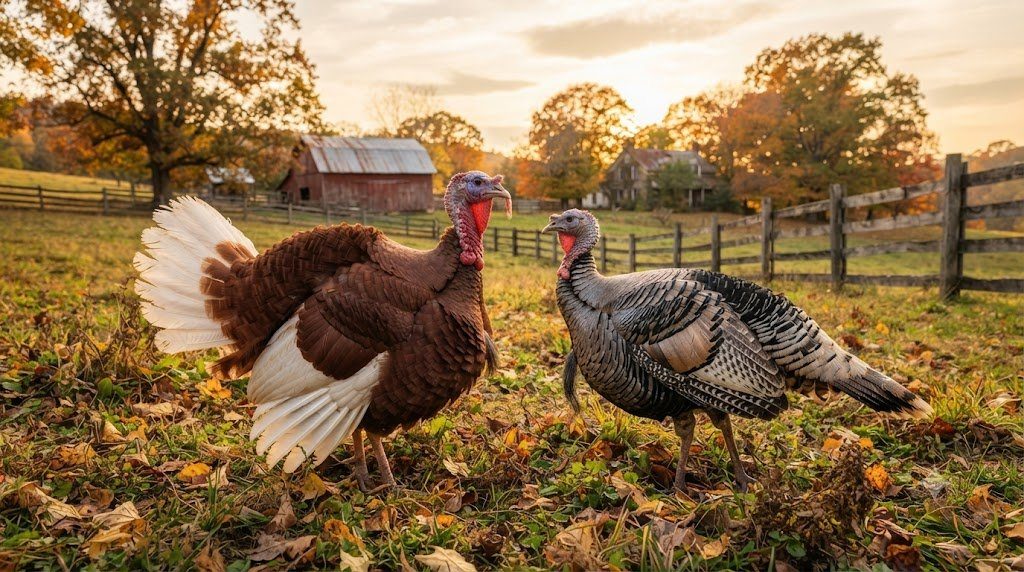
Domesticated turkey breeds (Meleagris gallopavo)—indigenous exclusively to the Americas—are sharply divided into two distinct genetic and physiological classifications: the industrial Broad Breasted White (BBW) and Broad Breasted Bronze (BBB) terminal hybrids, and the self-reproducing APA Heritage Turkey Breeds (anchored by the Standard Bronze, Bourbon Red, Narragansett, White Holland, Black Spanish, Slate / Blue, Beltsville Small White, and Royal Palm). While commercial Broad Breasted White toms achieve an extraordinary 38- to 45-pound live weight in just 18 to 20 weeks at a 2.3:1 feed conversion ratio, their extreme pectoralis major breast hypertrophy renders them physically incapable of natural copulation—making 100% of commercial turkey production dependent on human Artificial Insemination (AI). Conversely, Heritage turkeys mate naturally, fly, roost in trees, and forage aggressively on pasture, requiring 26 to 30 weeks to reach gourmet holiday maturity. Mastering turkey amino acid nutrition (28% starter protein), Histomonas meleagridis (Blackhead) protozoal prevention, and breed selection is essential for profitable turkey husbandry.
The Artificial Insemination (AI) Mandate in Broad Breasted Turkeys
Because intensive selection for breast width in Broad Breasted White and Broad Breasted Bronze turkeys shifted the bird’s center of gravity forward and widened the sternum by over 80%, mature toms (weighing 45 to 60 lbs) cannot physically mount hens without crushing them or failing to make cloacal contact. Consequently, 100% of commercial Broad Breasted poults are produced via weekly manual semen collection and intravaginal syringe insemination of breeder hens. To maintain a self-reproducing homestead flock, producers must select true APA Heritage breeds.
1. Historical Domestication, Genetic Divergence, and Breed Classifications
All domestic turkeys descend from the South Mexican wild turkey (Meleagris gallopavo gallopavo), domesticated by the Aztec and Mayan civilizations over 2,000 years ago, transported to Spain in 1519, refined into European color varieties, and reintroduced to colonial North America where they were crossed with the Eastern Wild Turkey (M. g. silvestris):
- Broad Breasted White (Commercial Terminal Hybrid – Nicholas, Hybrid, Butler): Developed in the 1950s at Cornell University and commercial farms by crossing the Broad Breasted Bronze with the White Holland. Carrying the autosomal recessive Color-Inhibitor gene ($c/c$), their pure white plumage leaves zero dark melanin pinfeather spots in the skin follicles when plucked at any age, making them the 99% standard of the global turkey meat processing industry.
- Broad Breasted Bronze (BBB) & Orlopp Bronze: Originating in the 1920s when British immigrant Jesse Throssell in British Columbia crossed massive English Sheffield Bronze stock onto North American Bronze flocks. Identical in double-breasted conformation and growth rate to the Broad Breasted White (also requiring AI to reproduce), the BBB retains iridescent copper-bronze plumage and is favored by direct-market farms for its striking visual pasture appeal.
- Standard Bronze & Narragansett (Foundational Heritage Breeds): The Standard Bronze (recognized by the APA in 1874) is the largest of the natural-mating heritage breeds (toms 25 to 36 lbs). The Narragansett—developed around Narragansett Bay, Rhode Island, in the 1600s and 1700s—carries a sex-linked recessive silver/steel-grey gene ($n$) that replaces coppery bronze barring with metallic steel-grey and black bands, prized for calm disposition and maternal brooding instinct.
- Bourbon Red & Jersey Buff (Richly Pigmented Heritage Table Birds): Developed in Bourbon County, Kentucky, in the late 1800s by J.F. Barbee from Buff, Bronze, and White Holland crosses. Sporting a deep brownish-red mahogany body with stark pure white primary wing and tail feathers ($b^1/b^1, r/r$), the Bourbon Red is universally acclaimed by chefs as the finest-tasting heritage table turkey due to its rich subcutaneous and intramuscular fat layer.
- Beltsville Small White, Midget White & Royal Palm: The Beltsville Small White was engineered by the USDA Agricultural Research Center in Beltsville, Maryland, between 1934 and 1941 to fit small apartment ovens (dressing out at 8 to 14 lbs with a remarkably wide heritage breast). The Royal Palm (emerged in Florida in the 1920s) is a striking black-and-white pied ornamental and light-meat heritage breed famous for autonomous biological tick and grasshopper eradication.
2. Comparative Turkey Breed Growth, Weight, and Carcass Metrics
Evaluating commercial Broad Breasted hybrids alongside the premier APA Heritage breeds demonstrates the stark contrast in maturity age, breast-to-leg ratio, and reproductive independence:
Under strict definition by the American Poultry Association and The Livestock Conservancy, a true Heritage Turkey must meet three non-negotiable biological criteria: (1) It must mate and reproduce naturally without artificial insemination; (2) It must have a long, productive outdoor lifespan (breeding hens living 5 to 7 years and toms 3 to 5 years); and (3) It must have a slow growth rate, reaching marketable table weight in no less than 26 to 28 weeks, giving the skeleton and internal organs time to develop harmoniously.
3. Poult Brooding Behavior, Imprinting, and ‘Starve-Out’ Prevention
Newly hatched day-old turkey poults are notoriously fragile during their first 10 days of life compared to baby chicks, possessing poor visual acuity in dim light and a strong evolutionary reliance on maternal vocal and visual imprinting:
Preventing Poult ‘Starve-Out’ and Litter Eating
Unlike baby chicks that instinctively scratch and peck at feed immediately after hatching, wild turkey poults evolved to watch their mother’s beak pick insects off eye-level grass stems. In an artificial brooder, poults frequently fail to recognize dull brown feed crumbles on the floor, dying of dehydration and hypoglycemia at Day 4 to 6 (‘Poult Starve-Out’) or impacting their gizzards by eating wood shavings. Producers prevent starve-out by covering wood shavings with high-traction paper towels for the first 5 days, providing bright 50-lux light directly over feeders, and placing shiny glass marbles or bright green chopped hard-boiled egg/dandelion greens into waterers and feed pans to trigger curiosity pecking.
Furthermore, poults require a higher initial brooder temperature of 95°F to 98°F at poult back height during Week 1 inside a circular cardboard draft guard (to prevent fatal corner piling), reduced by 5°F per week until fully feathered at Week 6 to 8 (when they ‘shoot the red’—developing the vascularized red caruncles and snood on the head and neck, after which they become remarkably cold-hardy).
4. High-Protein Amino Acid Nutrition and Biotin/Niacin Demands
Turkey poults possess a dramatically higher dietary protein, lysine, methionine, niacin, and biotin requirement than chicken chicks. Attempting to raise turkey poults on standard 18% chick starter causes severe stunted growth, crooked perosis hocks, and feather picking:
For Heritage turkeys scheduled for Thanksgiving harvest (seeded in late April or early May for a 28-week grow-out), switching to a 15% protein high-energy grain finisher (whole/cracked corn, roasted soybeans, wheat, and pasture acorns/clover) during the final 4 weeks in cool October/November weather stimulates the bird to deposit a protective creamy layer of subcutaneous fat over the breast, ensuring self-basting succulence in the oven.
5. Histomonas meleagridis (Blackhead Disease) and Chicken Separation
The #1 infectious killer of pasture-raised turkeys is Histomoniasis (Blackhead Disease), caused by the flagellated protozoan parasite Histomonas meleagridis. Understanding its complex three-host biological transmission cycle is vital for every poultry producer:
- The Cecal Worm & Earthworm Vector Loop: Naked Histomonas protozoa die within minutes outside the bird’s body. However, the protozoan invades the microscopic eggs of the common poultry cecal nematode worm (Heterakis gallinarum). Protected inside the thick shell of the cecal worm egg (and further concentrated inside common pasture earthworms that ingest those cecal worm eggs), Histomonas remains infective in pasture soil for 3 to 4 years.
- Asymptomatic Chicken Carriers vs. 90% Turkey Mortality: Domestic chickens harbor Heterakis cecal worms and shed millions of Histomonas-infected eggs in their droppings while appearing 100% healthy and asymptomatic. When a turkey scratches in soil previously grazed by chickens and eats an infected earthworm or cecal worm egg, the protozoan perforates the turkey’s ceca and migrates via the portal vein to the liver—producing classic circular yellow ‘bull’s-eye’ necrotic liver craters, sulfur-yellow droppings, and 70% to 100% flock mortality.
- Biosecurity & Management Prevention: Never brood or pasture turkeys on ground used by chickens within the past 3 years. Rotate turkey mobile roost shelters onto clean cattle/sheep pastures every 4 to 7 days, control Heterakis cecal worms with fenbendazole where indicated, and supplement water with oregano essential oil (carvacrol) and acidified copper sulfate.
6. Veterinary Health: Mycoplasma, Erysipelas, and Fowl Pox
Commercial and heritage turkey breeders enforce strict testing under the National Poultry Improvement Plan (NPIP):
- Infectious Sinusitis (Mycoplasma gallisepticum & Mycoplasma meleagridis): Causes severe swelling of the infraorbital sinuses below the eyes, foamy ocular discharge, and airsacculitis. Because Mycoplasma is transmitted vertically inside the hatching egg, poults must be sourced strictly from NPIP U.S. Mycoplasma Gallisepticum/Synoviae/Meleagridis Clean hatcheries.
- Erysipelas (Erysipelothrix rhusiopathiae): A soil-borne bacterium (shared with swine and sheep) that enters through tom fighting scratches on the snood or head, causing acute septicemia, swollen purple snoods, and sudden death in maturing toms. Prevented via bacterin vaccination in endemic soils.
- Avian Pox (Wet & Dry Fowl Pox): Vectored by late-summer mosquitoes, causing warty scabs on the unfeathered head/caruncles (Dry Pox) or diphtheritic yellow plaques choking the trachea and esophagus (Wet Pox). Prevented via wing-web vaccination at 8 to 10 weeks of age.
7. Enterprise Economics: Thanksgiving Direct-Market Margins
Pasture-raised Thanksgiving turkeys command the highest per-bird gross revenue in small-livestock farming. A pasture-raised Broad Breasted White or Bronze turkey consumes 75 to 90 pounds of feed ($22 to $28 feed cost + $9 poult cost), dresses out at 18 to 24 pounds, and sells direct-to-consumer for $6.50 to $8.50 per pound ($130 to $190 per bird)—yielding $85 to $130 net profit per bird in 18 weeks. True APA Heritage turkeys (Bourbon Red, Standard Bronze, Narragansett) consume 90 to 110 pounds of feed over 28 weeks, dress out at 12 to 18 pounds, and command luxury culinary prices of $11.00 to $15.00 per pound ($150 to $250 per bird).
8. Frequently Asked Questions (Technical Turkey Breeds & Husbandry FAQ)
Q: Why can’t Broad Breasted White and Broad Breasted Bronze turkeys mate naturally?
Decades of intense selection for extreme breast muscle weight (where the breast makes up over 35% of carcass weight) altered the skeletal center of gravity and shortened the shanks relative to sternum depth. Mature toms weighing 45 to 60 pounds physically cannot balance or achieve cloacal contact on hens without crushing them, requiring 100% artificial insemination.
Q: Why did the commercial turkey industry switch from the Broad Breasted Bronze to the Broad Breasted White in the 1960s?
When a dark-feathered Bronze turkey is plucked at 14 to 18 weeks of age, immature developing pinfeathers leave tiny spots of black/brown melanin pigment inside the feather follicles on the skin, which consumers mistook for dirt or bruising. The recessive white gene (c/c) in Broad Breasted Whites makes pinfeathers completely invisible against the skin.
Q: Why is it dangerous to raise turkeys and chickens together in the same pasture or barn?
Chickens are asymptomatic carriers of the cecal worm Heterakis gallinarum, whose microscopic eggs harbor the protozoan Histomonas meleagridis—the cause of Blackhead Disease. While chickens show zero illness, turkeys that ingest chicken droppings or earthworms from chicken pastures suffer 70% to 100% fatal necrotic liver and cecal failure.
Q: What happens if you feed day-old turkey poults 18% chick starter instead of 28% turkey starter?
Rapidly growing turkey poults require 28% to 30% crude protein and 1.7% lysine during their first 4 weeks of life, plus double the niacin, biotin, and calcium/phosphorus of chicks. Feeding 18% chick starter causes severe amino acid starvation, stunted feathering, bowed legs (perosis / slipped tendon), and high mortality.
Q: What does ‘shooting the red’ mean in young turkey poults, and why is it a major milestone?
Around 6 to 8 weeks of age, juvenile turkey poults undergo an androgen/endocrine surge where the bare skin on their head and neck develops bright red, vascularized fleshy bumps (caruncles) and the fleshy snood elongates over the beak (‘shooting the red’). Once a poult shoots the red, its juvenile thermoregulatory fragility ends and it becomes hardy against rain and cold.
Q: How do you cook a Heritage Turkey differently from a supermarket Broad Breasted turkey?
A Heritage turkey (like a Bourbon Red or Narragansett) has active, exercised dark thigh muscles, a prominent high keel bone, and less water injected into the breast. It should be roasted at a slightly higher temperature (375°F–400°F) inside a covered roasting pan with stock/butter basting for 30% LESS time, pulling the bird the moment the deepest breast hits 155°F–160°F (resting to 165°F).
Q: Which heritage turkey breed is best for small families wanting a 10- to 12-pound holiday bird?
The Beltsville Small White (developed by the USDA in the 1930s) and the Midget White are the premier small-bodied table turkeys. Unlike the Royal Palm (which is primarily an ornamental/insect-control bird with a narrower breast), the Beltsville Small White was specifically bred to have a plump, well-fleshed breast on a compact 10- to 14-pound carcass.
Q: Can virgin unmated turkey hens produce fertile hatching eggs via parthenogenesis?
Remarkably, yes! Turkeys exhibit the highest rate of facultative avian parthenogenesis (virgin birth) studied in domestic birds (documented extensively by Dr. Marlow Olsen at the USDA in Beltsville). In Beltsville Small White flocks isolated from toms, up to 30–40% of unfertilized eggs show parthenogenetic embryonic cell division, and a small percentage actually hatch into viable, 100% homozygous diploid male (ZZ) poults.