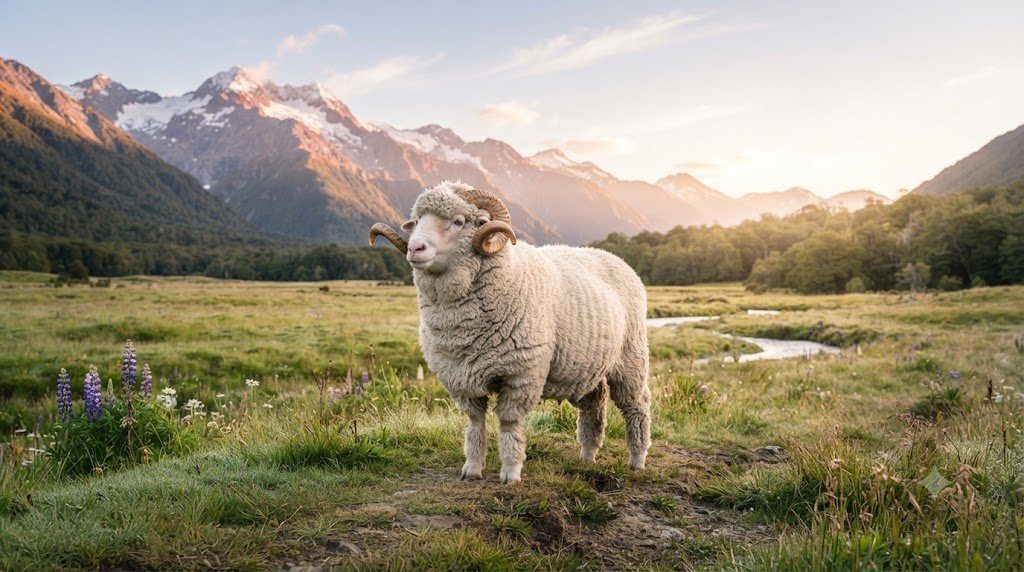
Fine-wool and dual-purpose range sheep breeds—led by the Australian and Spanish Merino, the French/American Rambouillet, the New Zealand Corriedale, and the USDA-developed Targhee and Columbia—form the foundation of global apparel textile wool production and extensive Western rangeland sheep ranching. Evolved to thrive in semi-arid basins, alpine meadows, and rugged sagebrush steppes, these breeds combine extraordinary secondary-to-primary dermal wool follicle density with strong flocking (gregarious) instincts, seasonal longevity, and high-efficiency maternal lamb production. Mastering wool metrology (average fiber diameter in microns, comfort factor, crimp frequency, and clean scoured yield), National Sheep Improvement Program (NSIP) Estimated Breeding Values (EBVs), and range husbandry is essential for maximizing both wool clip checks and feeder lamb revenue.
The Secondary-to-Primary Follicle (S:P) Ratio in Fine Wool
The defining histological difference between a fine-wool Merino/Rambouillet and a coarse-wool or meat sheep is the ratio of secondary wool follicles (which produce ultra-fine, non-medullated true wool fibers) to primary follicles. While meat breeds possess an S:P ratio of only 4:1 to 6:1, elite superfine Merinos and Rambouillets exhibit an S:P ratio of 18:1 to 28:1—packing up to 60,000 individual wool fibers into every square inch of skin.
1. Historical Origins, Pedigree Evolution, and Range Breed Taxonomies
Fine-wool and dual-purpose white-faced range breeds trace their foundational wool genetics back to the royal Mesta transhumance flocks of medieval Spain before undergoing specialized selection across France, Australia, New Zealand, and the American West:
- Merino (Spanish, Australian & Delaine): Originating in Spain (where exporting a Merino was punishable by death until the late 1700s), the Merino was refined in Australia into Peppin (medium), Saxon (superfine/ultrafine), and South Australian (strong) strains, and in the U.S. into the smooth-bodied Delaine Merino. Unrivaled in fiber softness (11.5 to 21.0 microns), high lanolin (suint/grease) content, and dense staple architecture.
- Rambouillet (French Merino): Development began in 1786 when King Louis XVI purchased 366 Spanish Merinos for his royal estate at Rambouillet, near Paris. French geneticists selectively bred for a much larger, smoother, heavier-muscled carcass frame while preserving fine apparel wool. Today, the Rambouillet is the cornerstone maternal range ewe of the Western United States (Texas, Wyoming, Montana).
- Corriedale (Dual-Purpose Inbred Cross): The oldest of all stabilized crossbred dual-purpose breeds, developed simultaneously in New Zealand and Australia between 1868 and 1911 by inter-breeding F1 Lincoln Longwool and Leicester rams with Merino ewes. Corriedales produce heavy, lustrous medium-grade fleeces (25 to 31 microns) with high staple length alongside plump, fast-maturing market lambs.
- Columbia & Targhee (U.S. Western Range Composites): Developed at the USDA Sheep Experiment Station in Dubois, Idaho. The Columbia (1912) fixed a 50% Lincoln Longwool / 50% Rambouillet cross into a massive, open-faced, polled dual-purpose breed. The Targhee (1926) stabilized a 3/4 Rambouillet, 1/4 longwool (Lincoln/Corriedale) composition, capturing the ideal 21- to 24-micron wool fineness with open-faced range maternal hardiness.
2. Comparative Wool Metrology and Carcass Production Benchmarks
Evaluating the five premier fine-wool and dual-purpose breeds demonstrates how wool micron diameter inversely correlates with mature carcass frame size and lamb growth rate:
In international wool auctions, clean wool price per pound increases exponentially as average fiber diameter drops below 19.5 microns (the threshold for next-to-skin luxury activewear garments). However, on cold, windy Western mountain ranges, the larger body mass and heavier twin weaning weights of Rambouillet and Targhee ewes generate higher combined enterprise income (65% from feeder lambs, 35% from wool).
3. Wool Physics: Micron Diameter, Comfort Factor, and Crimp Mechanics
Commercial wool clip valuation relies on objective laboratory testing (via OFDA2000 or LaserScan core sampling) across five physical parameters:
- Average Fiber Diameter (AFD) & Coefficient of Variation (CVd): Measured in micrometers ($\mu ext{m}$). Lower CVd (< 18%) indicates uniform fiber thickness across the fleece, which improves yarn spinning speed and reduces prickle.
- Comfort Factor (% of Fibers < 30.5 Microns): Human cutaneous nerve endings perceive wool fibers thicker than 30.5 microns as stiff and ‘itchy/prickly’ because thick fibers fail to bend against the skin. Fine-wool Merinos and Rambouillets achieve a 98.5% to 99.9% Comfort Factor.
- Crimp Frequency & Ortho-/Para-Cortex Bilateral Structure: Fine wool exhibits 12 to 20 three-dimensional sinusoidal waves (crimps) per inch. This natural elasticity results from the bilateral arrangement of ortho-cortical and para-cortical cells inside the keratin shaft, which expand at different rates and trap insulating dead-air pockets.
- Staple Strength (Newtons per Kilotex – N/ktex): Measures resistance to breaking during high-speed worsted combing (minimum 30 to 35 N/ktex required). Severe nutritional stress, fever, or late-gestation ketosis causes a narrow weak point (‘tender wool’ or ‘wool break’) along the staple shaft, severely discounting fleece value.
Eliminating Wool Blindness (Open-Face Selection)
Historically, excessive wool growth over the infraorbital face and eyelids (‘wool blindness’) caused range ewes to become disoriented, separated from the band, or blinded by speargrass awns, slashing lifetime lamb weaning weights by 15% to 20%. Modern Rambouillet, Targhee, and Merino breeders select heavily for natural ‘Open-Face’ genetics, eliminating the labor of crutching eye-wool.
4. NSIP Estimated Breeding Values (EBVs) and the Western Range Index
Genetic improvement across fine-wool and dual-purpose flocks in North America is coordinated through the National Sheep Improvement Program (NSIP) in partnership with Australia’s LAMBPLAN, utilizing the U.S. Western Range Index:
Because Clean Fleece Weight (CFW) and Fiber Diameter (FD) have an unfavorable positive genetic correlation ($r_g = +0.25$, meaning heavier fleeces tend to become coarser), using the NSIP Western Range Index allows breeders to identify rare ‘curve-bender’ rams that simultaneously increase clean fleece weight while decreasing micron diameter.
5. Gregarious Flocking Instinct, Transhumance Herding, and Predator Defense
On unfenced public Bureau of Land Management (BLM) and U.S. Forest Service grazing allotments spanning tens of thousands of acres, sheep survival depends on the gregarious flocking instinct inherited exclusively from Merino and Rambouillet bloodlines.
Unlike British hill or down sheep (such as Suffolks or Cheviots) that scatter across pastures as independent individuals, Rambouillet, Merino, and Targhee ewes graze and bed down in a tight, cohesive band. This flocking behavior allows a single herder accompanied by working Border Collies and 3 to 5 Livestock Guardian Dogs (Great Pyrenees, Akbash, Anatolian Shepherd, or Maremma) to move and protect a band of 1,000 ewes and their 1,500 lambs across rugged mountain terrain while deterring coyotes, wolves, bears, and mountain lions.
6. Nutritional Sulfur Amino Acids, Flushing, and Shearing Protocols
Wool keratin protein contains an exceptionally high concentration of the sulfur-bearing amino acid cysteine (10% to 13% by weight). Because rumen microbes degrade unprotected dietary protein, wool growth is strictly limited by the post-ruminal supply of sulfur-containing amino acids (methionine and cysteine) reaching the abomasum and small intestine:
- Nitrogen-to-Sulfur Ratio (10:1 Target): Range mineral supplements and winter protein blocks for wool sheep must maintain a strict 10:1 Nitrogen-to-Sulfur ratio (compared to 15:1 for beef cattle) so rumen microbes can synthesize microbial methionine.
- Pre-Breeding Nutritional Flushing: Increasing dietary energy (adding 0.50 to 0.75 lbs of whole corn or barley per ewe daily for 17 days prior to ram turnout) stimulates hepatic insulin-like growth factor and FSH release, boosting ovulation and twinning rates by 15% to 25%.
- Pre-Lambing Shearing & Contamination Control: Shearing ewes 3 to 4 weeks prior to spring lambing offers massive benefits: fleeces are shorn before gestational stress causes a ‘wool break’, shorn ewes seek indoor shelter during storms (protecting newborn wet lambs from hypothermia), lambs locate teats immediately without sucking dirty belly-wool tags, and 30% more ewes fit inside the lambing barn.
- Eliminating Polypropylene Twine Contamination: Never allow plastic baling twine in sheep hay yards; a single shred of polypropylene plastic combed into a 600-pound wool bale ruins the entire textile dye lot. Wool must be packed strictly in approved high-density polyethylene (HDPE) wool packs after skirting out stained belly, leg, and britch wool.
7. Veterinary Health: Blowfly Strike (Myiasis), Footrot, and Caseous Lymphadenitis
Fine-wool sheep require targeted veterinary protocols to manage fleece and skin health:
- Cutaneous Myiasis (Blowfly Strike – Lucilia cuprina): Heavy-wrinkled Merinos are vulnerable to moisture and bacterial fleece rot in the breech and shoulder folds, attracting blowflies whose maggots consume living tissue. Modern breeders eliminate surgical ‘mulesing’ by selecting genetically Plain-Bodied / Smooth-Skinned Merinos and Rambouillets with bare breeches, combined with timely crutching.
- Shearing Shed Biosecurity Against Caseous Lymphadenitis (CL): Because Corynebacterium pseudotuberculosis spreads rapidly when shearing handpieces nick an abscess, commercial shearing crews shear young replacement ewe lambs first, followed by yearlings, and mature ewes last, disinfecting combs and cutters between cohorts.
8. Enterprise Economics: Dual Revenue Streams (Wool Checks + Feeder Lambs)
A dual-purpose Rambouillet or Targhee range flock generates resilient two-pronged cash flow: First, an 11-pound grease fleece yielding 6.2 pounds of clean 20-micron wool sells for $4.20 to $5.80 per clean pound ($26 to $36 per ewe), which covers 100% of annual shearing, winter mineral, and vaccination expenses. Second, mating the bottom 60% of the range ewes to terminal Suffolk or Hampshire rams produces a 145% to 165% weaned crop of 90-pound crossbred feeder lambs worth $180 to $220 per lamb—delivering $260 to $340 in gross lamb revenue per ewe exposed.
9. Frequently Asked Questions (Technical Fine-Wool & Range Sheep FAQ)
Q: What is the difference between an Australian Merino and an American Rambouillet?
Both descend from the original Spanish Merino, but diverged in selection goals: the Australian Merino was selected primarily for maximum fleece weight and ultra-fine wool (14 to 19 microns) on a smaller body frame. The Rambouillet (French Merino) was selected as a true dual-purpose animal, featuring a 30% to 40% larger muscular carcass frame and fast-growing lambs alongside fine 19- to 22-micron apparel wool.
Q: What does ‘Comfort Factor’ mean on an OFDA2000 wool test report?
Comfort Factor measures the exact percentage of individual wool fibers in a core sample that measure less than 30.5 microns in diameter. Because fibers thicker than 30.5 microns fail to buckle when pressed against human skin (causing a prickle/itch sensation), next-to-skin base-layer textile mills require a Comfort Factor of 98% or higher.
Q: What causes a ‘wool break’ or ‘tender wool’ in a shorn fleece?
Wool follicles undergo rapid mitosis and require continuous amino acid and glucose delivery. If a ewe suffers a high fever, acute starvation during a blizzard, severe parasite anemia, or late-gestation twin lambing stress, wool follicles temporarily shut down protein synthesis, creating a thin, weak constriction point along the fiber shaft that snaps during mechanical carding and combing.
Q: How was the Targhee sheep breed created, and why is it popular in the Northern Rockies?
Created in 1926 by the USDA Sheep Experiment Station in Dubois, Idaho, the Targhee is a stabilized composite of 3/4 Rambouillet and 1/4 longwool genetics (Lincoln and Corriedale). It was specifically engineered to thrive on cold sagebrush and mountain ranges while weaning heavy twin lambs and clipping a high-value 21- to 23-micron fleece.
Q: Why is pre-lambing shearing preferred over post-lambing shearing in cold northern climates?
When ewes are shorn 3 to 4 weeks before lambing, the wool clip is harvested before lambing stress can cause a staple break, freeing the fleece of manure tags. Furthermore, shorn ewes feel cold wind and voluntarily walk inside barns or windbreaks before giving birth, keeping fragile wet newborn lambs out of freezing snowstorms.
Q: Why do wool sheep require a 10:1 Nitrogen-to-Sulfur ratio in their diet?
Wool keratin is composed of 10% to 13% cysteine, a sulfur-containing amino acid. For rumen bacteria to synthesize sufficient sulfur-bearing microbial amino acids from non-protein nitrogen or range forage, dietary sulfur must be supplied at a 10:1 Nitrogen-to-Sulfur ratio (compared to 15:1 in non-fiber cattle).
Q: What is ‘skirting’ a fleece on the shearing floor, and why does it increase clip value?
Immediately after a fleece is shorn, wool handlers throw it onto a slatted skirting table and remove all coarse, stained, or vegetable-matter-contaminated edges—including urine-stained belly wool, manure-tagged britch wool, and coarse leg hair. Separating these low-grade off-sorts keeps the main fleece line pure white and uniform in micron, earning top mill prices.
Q: Why do fine-wool sheep flock tightly together while British meat sheep scatter?
For over 600 years during the Spanish Mesta transhumance migrations, Merinos were driven 400 miles each spring and autumn across open country by shepherds and mastiffs; any sheep that wandered away from the tight flock was eaten by wolves or killed. This intense behavioral selection fixed strong gregarious flocking genes in all Merino-descended breeds.