Commercial meat and fiber goat production represents one of the fastest-growing livestock sectors worldwide, driven by surging consumer demand for lean chevon (goat meat), sustainable brush biological control, and luxury natural textile fibers (mohair and cashmere). While the muscular South African Boer and white Savanna dominate show rings and terminal carcass conformation, hardy maternal range breeds—specifically the New Zealand Kiko, American Spanish brush goat, and Tennessee Myotonic—provide the parasite resistance, hoof soundness, and zero-input maternal survival required for extensive pasture profitability. Simultaneously, specialized fiber breeds led by the Angora and Cashmere exhibit extraordinary secondary hair follicle metabolic activity. Mastering the F1 crossbreeding synergies, Haemonchus contortus parasite genetics, and nutritional browse physiology of these breeds is key to commercial success.
The Maternal Kiko x Terminal Boer Crossbreeding Matrix
In humid pastures where internal parasites (Haemonchus contortus) devastate high-input purebred Boer herds, commercial producers achieve peak profitability by maintaining a maternal foundation flock of purebred Kiko or Spanish does and mating them to heavy-muscled Boer or Savanna terminal sires. This F1 cross captures maximum hybrid vigor: 185% weaning kid crop, 60% lower deworming treatments, and grade-A muscular market kids.
1. Origins, Genetic Evolution, and Functional Breed Classifications
Meat and fiber goat breeds are classified by their evolutionary selection pressures—ranging from intensive carcass conformation to ruthless natural survival on predator-heavy scrublands:
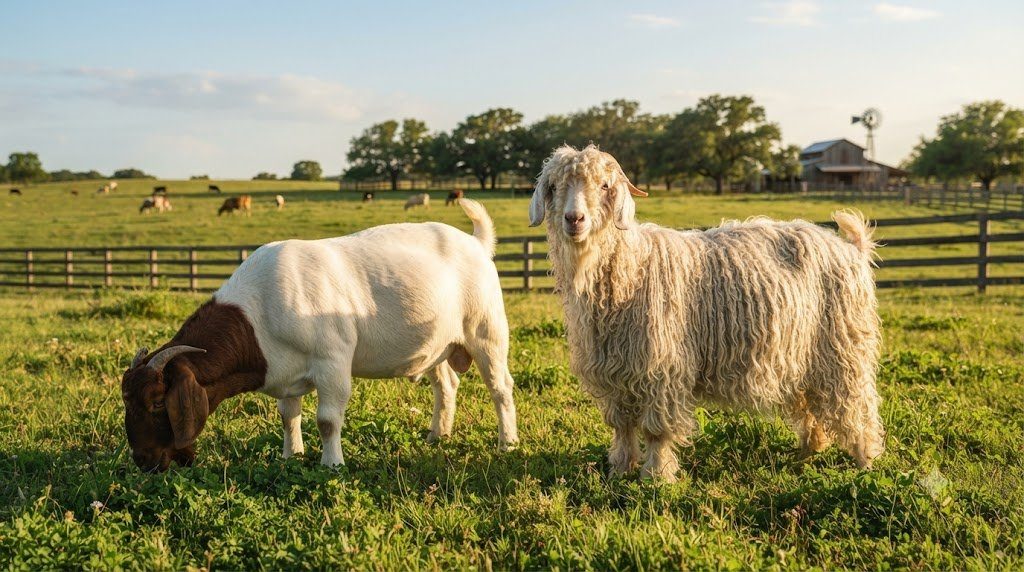
- South African Boer: Developed in the Eastern Cape province of South Africa during the early 1900s by crossing indigenous Khoikhoi/Bantu landrace goats with European and Indian bloodlines, with a breed standard finalized in 1959 for the ‘Improved Boer.’ Characterized by a massive, barrel-chested muscular frame, Roman nose, pendulous ears, and a classic white body with a dark cherry-red head and neck (plus modern Traditional, Red, Black, and Dappled color registries).
- New Zealand Kiko: Synthesized in the 1980s by Garrick and Anne Batten of the Goatex Group on the North Island of New Zealand. They captured thousands of wild, feral range does that had survived decades of natural selection in steep, wet bush country and crossed them with Anglo-Nubian, Toggenburg, and Saanen dairy bucks to boost milk and frame growth. Selected strictly under a ruthless ‘no-hoof-trimming, no-deworming, no-shelter’ survival protocol; ‘Kiko’ is the Maori word for flesh or meat.
- South African Savanna (White Boer): Developed starting in 1957 along the Vaal River in South Africa by Cilliers and Sons as an ultra-hardy, all-white meat goat. Beneath their stark white, short summer coat (which reflects solar radiation), purebred Savannas possess 100% jet-black epidermal skin, horns, hooves, and mucous membranes, providing absolute immunity against ultraviolet sunburn and extremely tough black hooves.
- American Spanish (Brush / Woods Goat): Descended from early 16th-century Iberian goats brought to Texas, Mexico, and the American Southwest by Spanish explorers. Subjected to 400 years of ruthless survival-of-the-fittest selection on arid Edwards Plateau mesquite brush and humid southeastern pinewoods, Spanish lines (such as Weinheimer, Hyden, and Koy Ranch bloodlines) excel in maternal instinct, twin weaning efficiency, and drought survival.
- Myotonic (Tennessee Fainting Goat): A unique North American heritage meat breed carrying an autosomal recessive missense mutation in the Skeletal Muscle Chloride Channel gene (CLCN1). When startled, sudden voluntary muscle contraction experiences delayed relaxation (myotonia congenita) for 5 to 15 seconds. This chronic isometric muscle tension produces extraordinary muscular hypertrophy, yielding a 6% to 8% higher meat-to-bone ratio and exceptional tenderness.
- Angora & Cashmere Fiber Breeds: The Angora (originating in the Ankara region of Turkey, concentrated in the Texas Edwards Plateau) is a single-coated breed whose secondary follicles grow continuous, lustrous mohair ringlets at 0.8 to 1.0 inches per month. Cashmere is not a single breed, but a genetic classification of double-coated goats (such as Spanish, Australian Cashmere, and Liaoning) that grow an ultra-fine insulating winter down undercoat (< 18.5 microns) beneath coarse guard hairs.
2. Comparative Meat & Fiber Breed Production Benchmarks
Comparing the major meat and fiber goat breeds reveals stark differences between high-input terminal conformation and low-input maternal efficiency:
In extensive university forage trials (such as those conducted at Tennessee State University by Dr. Richard Browning), Kiko and Spanish dams consistently weaned more total pounds of kid per 100 pounds of maternal doe body weight than purebred Boer dams under humid pasture conditions without supplemental grain, owing to dramatically lower doe mortality, zero hoof-rot lameness, and superior twin survival.
3. Haemonchus contortus Parasite Genetics and FAMACHA Selection
The single greatest biological threat to pasture-based goat operations is the hematophagous (blood-sucking) abomasal nematode Haemonchus contortus (Barber Pole Worm). Because goats evolved as arid browsers feeding 3 to 5 feet off the ground rather than ground-level grazers, they developed stronger behavioral avoidance than immunological resistance when forced onto short grass pastures:
Genetic Heritability of Fecal Egg Count (FEC) Resistance
Genetic resistance to Haemonchus contortus—measured via Quantitative Fecal Egg Counts (FEC) and Packed Cell Volume (PCV)—is moderately heritable in meat goats (h2 = 0.25 to 0.35). Kiko, Spanish, and Myotonic bloodlines mount a rapid mucosal IgA and eosinophil immune response that expels L3 larvae and suppresses female worm fecundity. Selecting bucks in the top 10% for negative FEC EBVs permanently lowers whole-flock worm burdens.
Commercial producers manage anthelmintic resistance by enforcing Targeted Selective Treatment (TST) using the FAMACHA© eyelid anemia score (1 to 5 scale) combined with the Five-Point Check: only goats scoring FAMACHA 4 or 5 (pale white conjunctiva) are dewormed using combination multi-class drenches (benzimidazole + levamisole + macrocyclic lactone), leaving FAMACHA 1 and 2 goats untreated to maintain susceptible worm refugia on pasture.
4. Browse Physiology, Tannin Detoxification, and Woody Brush Control
Goats are classified anatomically as intermediate selective browsers rather than bulk roughage grazers. Given free choice in diverse rangelands, a goat’s natural diet consists of 60% woody browse and shrubs, 30% broadleaved forbs/weeds, and only 10% grass:
- Prehensile Upper Lip & Bipedal Stance: A mobile, split upper lip and agile neck allow goats to strip tiny nutrient-dense leaves from thorny acacia, multiflora rose, blackberry brambles, and mesquite while standing upright on their hind legs up to 6 feet high.
- Salivary Proline-Rich Proteins (PRPs) & Condensed Tannins: Woody browse species (oak leaves, sericea lespedeza, sumac) contain high concentrations of bitter condensed tannins that cause toxic rumen stasis in cattle. Goats secrete specialized proline-rich salivary proteins that bind tannins harmlessly. Even better, moderate dietary condensed tannins (in crops like Sericea lespedeza) act as natural bio-anthelmintics, binding the cuticular proteins of Haemonchus contortus in the abomasum and slashing worm egg output by 50% to 70%.
- Mixed-Species Co-Grazing Synergies: Adding 1 to 2 meat goats per beef cow on brush-invaded pastures increases total land carrying capacity by 25% without competing with cattle for grass, as goats eradicate invasive woody weeds and restore open grassland swards.
5. Fiber Biology: Angora Mohair vs. Cashmere Down Follicle Mechanics
Goat skin contains two distinct histological structures: Primary hair follicles (which possess sebaceous glands, sweat glands, and arrector pili muscles, producing coarse medullated guard hair) and Secondary hair follicles (which produce pure, non-medullated luxury fiber):
Because Angora goats partition massive quantities of dietary energy and sulfur-containing amino acids (cysteine and methionine) continuously into mohair keratin synthesis, they are highly susceptible to post-shearing hypothermia during cold rain events and gestational abortion storms if underfed during late pregnancy.
6. USDA Selection Grades (1, 2, 3) and Ethnic Holiday Market Timing
Unlike beef cattle graded on intramuscular marbling, live meat goats are evaluated under USDA Institutional Meat Purchase Specifications (IMPS) Selection Grades 1, 2, and 3 based strictly on external skeletal muscle thickness across the loin, rack, and hind leg stifles:
- Selection No. 1 (Thick Muscling): Superior convex stifle bulges, wide loin eye, full chest floor, and thick shoulder muscling (characteristic of Boer, Savanna, Myotonic, and F1 Boer-Kiko crosses). Commands a $0.35 to $0.65 per pound live-weight premium at commercial auctions.
- Selection No. 2 (Moderate Muscling): Slightly narrower loin and flatter hind leg muscling with prominent spinous processes (typical of purebred Spanish or Kiko kids).
- Selection No. 3 (Inferior / Angular Muscling): Narrow, flat-muscled skeletal conformation (typical of cull dairy goat bucklings).
Commercial meat goat profitability is maximized by synchronizing kidding calendars with peak ethnic and religious holiday markets: Easter (Western and Orthodox Christian, demanding 30- to 45-lb milk-fed cabrito kids), Eid al-Fitr and Eid al-Adha (Islamic holidays advancing 11 days earlier each year on the lunar calendar, demanding 60- to 90-lb intact, unblemished wethers or bucklings), and Christmas / New Year / Caribbean festivals.
7. Enterprise Economics, Stocking Rates, and Herd Budgeting
Six to seven mature meat does (900 lbs combined weight) equal 1.0 Animal Unit (equivalent to one 1,000-lb beef cow), yet produce a 175% to 200% weaned kid crop weighing 50 to 65 pounds each at 120 days of age. A 100-doe Kiko/Spanish maternal flock bred to Savanna or Boer terminal bucks weans 180 kids annually; selling 60-lb Selection 1 kids at $3.10 to $3.80/lb live weight generates $33,000 to $41,000 in gross revenue on brushy hill land unsuitable for row crops.
8. Frequently Asked Questions (Technical Meat & Fiber Goat FAQ)
Q: Why do purebred South African Boer goats struggle more with internal parasites and hoof rot in humid climates than Kikos?
The Boer goat was developed in the semi-arid Karoo and Eastern Cape regions of South Africa (< 15 inches annual rainfall) where nematode larvae and hoof-rot bacteria desiccate on dry soil. The Kiko was bred specifically in high-rainfall New Zealand hill country under zero-intervention selection, culling any goat that required deworming or hoof trimming.
Q: What gives the Savanna goat superior ultraviolet sunburn and hoof-scald resistance despite its white hair coat?
Unlike white dairy goats (like Saanens) that have pink, unpigmented skin and white hooves, purebred Savanna goats carry dominant melanocyte genetics that produce 100% jet-black epidermal skin, black horn keratin, and dense black hooves underneath a white hair coat. The white hair reflects heat while the black skin blocks UV damage.
Q: How does the Myotonic (Tennessee Fainting) goat mutation increase meat yield and tenderness?
Myotonic goats carry a mutation in the CLCN1 skeletal muscle chloride channel gene, which delays muscle relaxation after a startle response. These brief, repetitive isometric contractions throughout the animal’s life act like natural resistance weight training, increasing muscle fiber cross-sectional area, elevating the meat-to-bone ratio by 6% to 8%, and increasing post-mortem meat tenderness.
Q: Why is Sericea lespedeza called a ‘natural dewormer’ for grazing meat goats?
Sericea lespedeza is a warm-season perennial legume rich in condensed tannins. When consumed by goats, condensed tannins bind directly to the cuticle and digestive tract of Haemonchus contortus worms in the abomasum, reducing female worm egg laying by up to 70% and damaging hatching L1 larvae in feces.
Q: What is the difference between mohair and cashmere fiber?
Mohair is the lustrous, smooth, curly single-coat fiber produced exclusively by Angora goats, shorn twice a year at 24 to 38 microns in diameter. Cashmere is the ultra-fine, soft, crimped winter down undercoat (strictly under 18.5 microns) grown beneath coarse guard hairs by double-coated goat breeds during cold winter months and harvested once in spring.
Q: Why are Angora does uniquely prone tohabitual abortion and stress-induced abortion storms?
Intensive genetic selection for maximum mohair fleece weight in Angora goats inadvertently selected for hyper-functioning adrenal glands that prioritize hair follicle nutrient partitioning over placental progesterone maintenance. If an Angora doe experiences sudden nutritional energy restriction during days 90 to 115 of gestation, fetal hypoglycemia triggers an adrenal cortisol surge that causes immediate abortion.
Q: How does USDA Selection Grading (1, 2, 3) differ from USDA Beef Quality Grading?
Beef quality grading evaluates internal carcass marbling (Prime, Choice, Select). Because goat meat (chevon) deposits almost all fat viscerally around the kidneys rather than intramuscularly, USDA goat Selection Grades 1, 2, and 3 evaluate live or carcass skeletal muscle conformation thickness across the hind leg, loin, and shoulder.
Q: What are the exact specifications required for kids marketed into the Islamic Eid al-Adha holiday market?
Eid al-Adha buyers require well-muscled Selection 1 kids weighing 60 to 90 pounds that are physically unblemished: many buyers prefer intact bucklings (or unblemished wethers depending on regional tradition) with un-docked tails, intact ears (no large notched ear tags), and healthy horns (not disbudded).