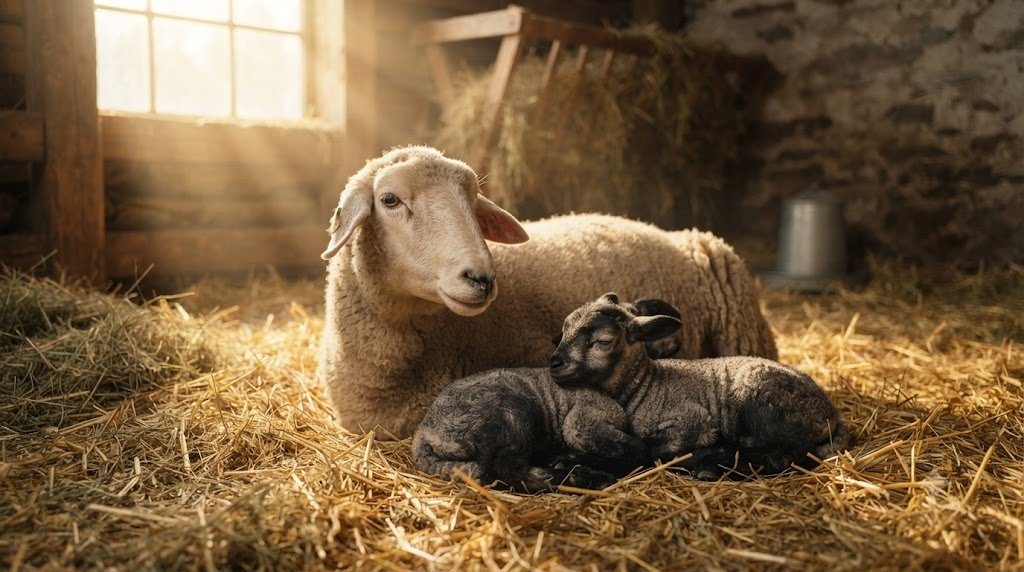
Specialized dairy, hyper-prolific, and heritage longwool sheep breeds—anchored by the German East Friesian, the French Lacaune, the British Milksheep, the prolific Romanov and Finnsheep (Finnish Landrace), and the lustrous Border Leicester, Lincoln Longwool, and Romney—provide the high-fecundity maternal genetics and artisanal dairy solids that power specialized ovine enterprises. Sheep milk contains nearly double the butterfat (6.0% to 7.5%) and true protein (5.2% to 6.0%) of cow or goat milk, serving as the irreplaceable raw ingredient for world-famous Roquefort, Pecorino Romano, Manchego, and Idiazabal cheeses. Simultaneously, introgressing major fecundity genes (such as the BMPR1B, BMP15, and GDF9 pathways) from Romanov and Finnsheep bloodlines allows commercial sheep producers to elevate flock weaning percentages from 130% up to 220%+.
The Ovine Cheese Yield Advantage (20% to 25% Curd Yield)
Because ovine milk contains 18% to 20% total solids (6.5% fat, 5.6% protein, and 50% more calcium and phosphorus than cow milk), cheesemakers require only 4.0 to 4.5 pounds of sheep milk to manufacture 1.0 pound of aged Pecorino or Manchego cheese—compared to 10 pounds of Holstein cow milk or 8.5 pounds of Saanen goat milk. Furthermore, sheep milk is the only commercial dairy fluid that can be blast-frozen at -15°F for 6 to 9 months without damaging casein curd coagulation.
1. Specialized Dairy Sheep Breeds: East Friesian, Lacaune, and Assaf
Commercial ovine dairying utilizes specialized breeds selected over centuries for machine-milking udder cisternal anatomy, lactational persistence, and high milk solids:
- East Friesian (Ostfriesisches Milchschaf): Originating in the coastal marshlands of East Frisia in northern Germany and the Netherlands. Universally recognized as the highest-volume dairy sheep breed in the world (producing 1,100 to 1,600+ lbs of milk per 220- to 240-day lactation). Distinguished by a large, angular frame, clean white woolless head and legs, and a signature woolless ‘rat tail’ that requires zero docking and stays clean in the milking parlor.
- Lacaune (French Roquefort Sheep): Native to the Tarn and Aveyron departments of southern France, where Lacaune milk is mandated under AOC law for genuine cave-aged Roquefort blue cheese. Through France’s rigorous national genomic selection program since the 1960s, the Lacaune has achieved extraordinary genetic gains in machine milkability, somatic cell resistance, and high butterfat/protein density (6.8% fat, 5.5% protein), while proving far hardier in large commercial flocks than purebred East Friesians.
- Awassi & Assaf (Middle Eastern / Mediterranean Dairy): The Awassi is a fat-tailed desert dairy sheep native to the Syro-Arabian desert, extremely tolerant of 105°F heat and drought. In 1955, Israeli geneticists crossed 5/8 Improved Awassi with 3/8 East Friesian to create the Assaf—now the dominant high-yielding dairy sheep across Spain, Portugal, and the Middle East.
- British Milksheep: Developed in England in the 1970s by Lawrence Alderson (combining East Friesian, Bluefaced Leicester, Polled Dorset, and Lleyn genetics) to create a prolific, dual-purpose dairy and lamb breed averaging 260% litter size and 1,200+ lbs of milk.
2. Hyper-Prolific Landraces: Romanov and Finnsheep (Northern Short-Tailed)
Belonging to the ancient Northern European Short-Tailed taxonomic group (characterized by natural 4- to 5-inch fluke-shaped short tails requiring zero docking), the Romanov and Finnsheep are utilized globally to inject extreme litter size and early sexual puberty into commercial maternal composites:
The Romanov (originating in the Upper Volga valley of Russia) is born jet-black and matures into a slate-blue/grey double coat of black wool and white guard hair. Purebred Romanov ewes reach puberty at 110 days of age, breed year-round, and routinely birth litters of 3, 4, or 5 vigorous lambs (holding the world record of 9 live lambs in a single birth). In commercial crossbreeding, a 1/4 Finnsheep or 1/4 Romanov bloodline infusion into Dorset or Rambouillet ewes (such as the USDA Polypay composite) boosts flock lambing percentage by 0.45 lambs per ewe per year.
3. Endocrinology of Major Fecundity Genes (BMPR1B, BMP15, GDF9)
While Romanov and Finnsheep prolificacy is primarily polygenic (involving dozens of additive loci that allow breeders to dial in exact litter sizes by breed percentage), several sheep breeds carry single-gene major mutations in the Transforming Growth Factor-Beta (TGF-$eta$) ovarian signaling pathway that dramatically alter ovulation rate:
The X-Linked BMP15 Homozygous Sterility Paradox
Mutations in the Bone Morphogenetic Protein 15 (BMP15 / Inverdale) gene on the X-chromosome exhibit a fascinating dosage paradox: ewes carrying one copy of the mutation (FecX+/FecXI) have reduced granulosa cell inhibition of FSH, causing them to ovulate an extra egg and twin consistently. However, ewes inheriting two copies (FecXI/FecXI) suffer complete arrest of primary ovarian folliculogenesis, resulting in sterile ‘streak ovaries.’ Breeders use DNA testing to maintain strictly heterozygous maternal carrier flocks.
4. Ovine Udder Cisternal Anatomy and Parlor Milking Physiology
Milking dairy ewes requires specialized parlor engineering and understanding of ovine mammary storage compartments. A ewe’s udder stores milk in two distinct anatomical compartments: Alveolar milk (trapped high in the microscopic secretory alveoli, requiring an active oxytocin neuroendocrine let-down reflex to expel) and Cisternal milk (drained freely into the large gland cistern awaiting immediate vacuum removal).
- Cisternal Storage Ratio & Teat Placement: East Friesian and Lacaune ewes store 50% to 70% of their milk in the gland cistern, compared to only 20% in dairy cows. However, if teat placement is too high on the lateral side of the udder (‘horizontal teats’ typical of poorly selected ewes), the bottom of the cistern sags below the teat orifice, trapping 250 mL of high-fat residual milk unless the milker performs manual ‘machine stripping’ (lifting the udder floor).
- Dairy Sheep Parlor Vacuum & Pulsation Settings: Because ovine teats are smaller and more sensitive than caprine or bovine teats, dairy sheep parlors operate at a low vacuum of 10.5 to 11.5 inches of mercury (36 to 38 kPa) paired with an ultra-fast pulsation rate of 120 to 180 pulsations per minute (50:50 ratio) to prevent teat congestion and mastitis.
- The 30-Day Lamb-Plus-Parlor (Share-Milking) System: Many farmstead sheep dairies allow lambs to nurse the ewes for the first 30 days (or nurse during the day while separating lambs overnight for morning parlor milking) before weaning lambs onto creep feed at 30 days and milking the ewes twice daily for the remaining 180 days.
5. Heritage Longwool & Lustre Breeds: Border Leicester, Lincoln, and Romney
Developed across the lush lowlands and marshes of Britain, the Longwool and Lustre breeds (Border Leicester, Bluefaced Leicester, Lincoln Longwool, Cotswold, and Romney) serve two vital industry roles:
First, their fleeces grow to extraordinary staple lengths of 6 to 12 inches per year (32 to 40 microns) with a high-refraction cuticular scale structure that reflects light like silk or mohair—making them the premier luxury hand-spinning, tapestry, and worsted outerwear fibers. Second, in the stratified British crossbreeding system, crossing a Bluefaced Leicester or Border Leicester ram onto hardy hill ewes (such as Scottish Blackface or Cheviot) produces the legendary ‘Mule’ or ‘Greyface’ F1 maternal ewe, which combines hill hardiness with 200% prolificacy and heavy milking ability when subsequently bred to a terminal Suffolk or Texel ram.
6. Veterinary Health: Ovine Progressive Pneumonia (OPP) and Pneumonia Sensitivity
Purebred East Friesian, Finnsheep, and Romanov flocks require rigorous respiratory biosecurity and retroviral monitoring:
- Ovine Progressive Pneumonia (OPP / Maedi-Visna Virus): An incurable small-ruminant lentivirus (closely related to caprine CAE) that causes chronic interstitial lymphoid pneumonia, dyspnea (‘heaving flanks’), and rock-hard indurative lymphoproliferative mastitis (‘hard bag’ with zero milk flow) in ewes over 3 years of age. Commercial sheep dairies must maintain OPP-Test-Negative Status via annual cELISA blood testing and colostrum deprivation/artificial lamb rearing.
- TMEM154 Gene Selection for OPP Resistance: USDA-ARS researchers at the U.S. Meat Animal Research Center (USMARC) discovered that amino acid variants in the Transmembrane Protein 154 (TMEM154) gene govern susceptibility to OPP infection. Sheep homozygous for Haplotype 1 (1,1) are nearly 3 to 4 times less likely to become infected with OPP virus than sheep carrying Haplotypes 2 or 3.
- Pasteurella / Mannheimia Pneumonia in Purebred East Friesians: Purebred 100% East Friesian sheep have relatively small thoracic lung volume and thin immune resilience under damp, poorly ventilated barn conditions. Consequently, most North American sheep dairies maintain crossbred Lacaune x East Friesian (50:50 or 75:25) dairy ewes, which exhibit 85% lower pneumonia mortality while producing equal milk solids.
7. Enterprise Economics: Farmstead Sheep Dairy and Blast-Frozen Milk Contracts
Farmstead and commercial sheep dairying offers the highest price per pound of raw milk in mainstream agriculture: wholesale Grade A or manufacturing sheep milk sells for $1.10 to $1.45 per pound ($110 to $145 per hundredweight)—nearly 6 times the price of cow milk. A crossbred Lacaune-East Friesian ewe producing 1,100 pounds of milk over a 210-day lactation generates $1,250 to $1,550 in milk revenue plus 2.1 crossbred feeder lambs worth $380 ($1,630+ total gross revenue per ewe). Because sheep milk freezes cleanly in 35-pound food-grade polyethylene bags inside a -15°F walk-in freezer without protein separation, seasonal pasture dairies can milk from April through October and sell frozen milk year-round to creameries.
8. Frequently Asked Questions (Technical Dairy, Prolific & Longwool Sheep FAQ)
Q: Why can sheep milk be frozen for 9 months for cheesemaking while frozen cow and goat milk fail to coagulate properly?
Sheep milk possesses exceptionally small, calcium-dense casein micelles and a high whey-protein-to-water ratio that prevents ice crystals from disrupting micellar casein stability at -15°F (-26°C). When thawed slowly, frozen sheep milk coagulates with rennet to produce identical cheese yields and textures to fresh milk.
Q: Why do commercial North American sheep dairies prefer Lacaune x East Friesian crosses over 100% purebred East Friesians?
While purebred East Friesians hold the record for fluid milk volume, they evolved as single-family pasture animals in northern Germany and suffer high mortality from Mannheimia haemolytica pneumonia and footrot when housed in large 300-ewe commercial flocks. Crossing with the French Lacaune restores flock hardiness, increases butterfat/protein percentages, and improves udder attachment via heterosis.
Q: How was the USDA Polypay sheep breed created, and what do the four breeds contribute?
Developed in 1968 at the U.S. Sheep Experiment Station in Dubois, Idaho, by Dr. Clarence Hulet, the Polypay (‘more than two’) is a 4-breed composite: 25% Finnsheep (high litter size & early puberty), 25% Dorset (out-of-season breeding & milking), 25% Targhee (flocking instinct & fine fleece), and 25% Rambouillet (range hardiness & longevity).
Q: What is the difference between polygenic prolificacy (Romanov/Finnsheep) and single-gene prolificacy (Booroola FecB)?
In single-gene mutations like the Booroola (BMPR1B) gene, a single copy jumps litter size by +1.5 lambs all at once, often surprising ewes with quadruplets they cannot feed. In polygenic breeds like Romanov and Finnsheep, prolificacy is controlled by dozens of small-effect genes—meaning a 25% Romanov cross increases litter size by a predictable +0.45 lambs, while a 50% cross increases it by +0.90 lambs.
Q: How does the TMEM154 gene test help eradicate Ovine Progressive Pneumonia (OPP)?
The TMEM154 gene encodes a cell-surface protein used by the OPP lentivirus to enter host macrophages. Sheep carrying two copies of Haplotype 1 (genotype 1/1, encoding lysine at position 35) have a mutated receptor that resists viral entry, drastically reducing horizontal transmission in the flock.
Q: Why are Romney sheep the dominant longwool breed in high-rainfall coastal marshes?
Originating in the windswept, waterlogged Romney Marsh of Kent in southeastern England, Romney sheep were naturally selected for dense, water-shedding 30-micron fleeces resistant to fleece rot and exceptionally hard hooves with high natural resistance to contagious ovine footrot (Dichelobacter nodosus).
Q: What is a ‘North Country Mule’ or ‘Scottish Mule’ ewe in the British stratified sheep system?
The British sheep industry operates a 3-tier pyramid: hardy mountain ewes (Scottish Blackface or Swaledale) graze rough highland heather; at 4 years of age they are moved down to foothills and bred to a Bluefaced Leicester longwool ram. Their F1 daughters—called ‘Mules’—are sold to lowland farms and bred to terminal Texel or Suffolk rams, capturing 100% maternal and terminal hybrid vigor.
Q: How do shepherds manage triplet and quadruplet lambs born to Romanov or Finnsheep ewes?
A healthy ewe has only two functional teats and can comfortably raise twins (or occasionally triplets on lush dairy rations). In high-prolificacy flocks, surplus third and fourth lambs are removed at 24 hours of age (after receiving maternal colostrum) and raised on an automated cold or warm ad-libitum lamb milk-bar feeder using 24% protein, 30% fat ovine milk replacer.