Across the subtropical, tropical, and arid grazing zones of the American Gulf Coast, Latin America, Australia, and Africa, standard European Bos taurus cattle suffer severe hyperthermia, tick-borne hemoparasitic mortality, and reproductive collapse. Profitable beef production in these high-heat, high-humidity ecosystems depends on Bos indicus (Zebu) genetics—anchored by the American Brahman—and stabilized synthetic composite breeds including Brangus, Beefmaster, Santa Gertrudis, and Braford, alongside tropically adapted Bos taurus Criollo lineages (Senepol, Romosinuano). Mastering the thermoregulatory physiology, slick-hair gene mutations, ectoparasite immunity, and F1 Tiger-Stripe heterosis of heat-tolerant cattle is foundational to tropical and subtropical ranching.
The F1 Tiger-Stripe (Brahman x Hereford) Phenomenon
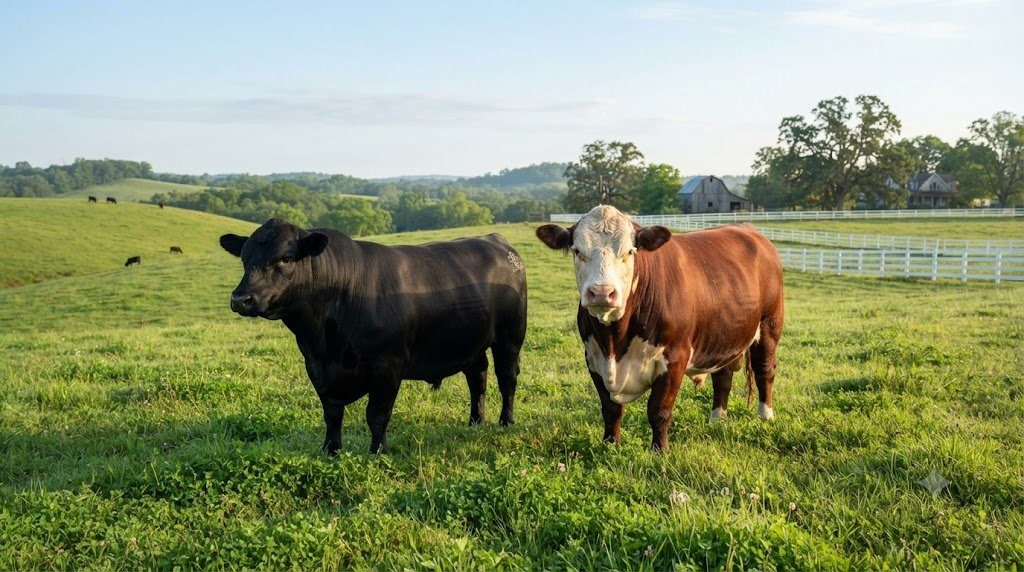
The F1 cross between a purebred American Brahman and a purebred Hereford—universally known as the ‘F1 Tiger-Stripe’ or ‘Braford F1’—exhibits the highest documented maternal heterosis in the global beef industry. Because Bos indicus and Bos taurus diverged evolutionarily over 500,000 years ago, their F1 hybrid daughters display a 25% to 35% advantage in lifetime pounds of calf weaned per cow exposed across harsh subtropical coastlines.
1. Evolutionary Divergence, American Brahman Origins, and Synthetic Composites
Humped Zebu cattle (Bos taurus indicus) diverged from humpless European taurine cattle (Bos taurus taurus) in the Indus Valley of the Indian subcontinent hundreds of thousands of years ago, evolving under intense selection for solar heat dissipation, monsoonal parasite pressure, and low-quality lignified C4 tropical grasses:
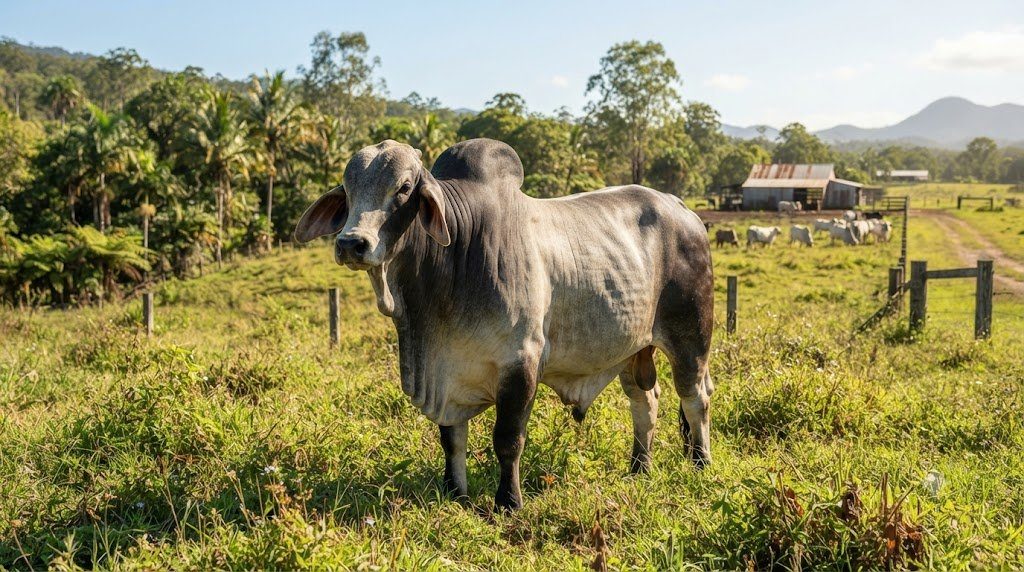
- American Brahman (100% Bos indicus): Synthesized in the Gulf Coast of Texas and Louisiana between 1885 and 1924 (when the American Brahman Breeders Association was founded) by blending four Indian Zebu strains: Guzerat, Nelore (Ongole), Gir, and Krishna Valley. Developed in two distinct registries—Red Brahman (strong Gir and Indu-Brazil influence) and Grey Brahman (strong Guzerat and Nelore influence).
- Brangus & Red Brangus (3/8 Brahman, 5/8 Angus): Stabilized by USDA researchers in Jeanerette, Louisiana, and Clear Creek Ranch in Oklahoma during the 1930s and 1940s. Combines the 37.5% Brahman heat/tick tolerance and maternal instinct with 62.5% Angus polledness, solid black/red hide, and carcass marbling.
- Santa Gertrudis (3/8 Brahman, 5/8 Beef Shorthorn): Developed on the legendary King Ranch in Kingsville, Texas, starting in 1910 around the foundation sire ‘Monkey’ and officially recognized by the USDA in 1940 as America’s first distinct beef breed. Deep cherry-red coat with loose skin folds and exceptional rangeland foraging ability.
- Beefmaster (Approx. 1/2 Brahman, 1/4 Hereford, 1/4 Shorthorn): Created by Tom Lasater in Falfurrias, Texas, during the 1930s under a strict, uncompromising ‘Six Essentials’ selection philosophy: Weight, Conformation, Milking Ability, Fertility, Hardiness, and Disposition.
- Braford (3/8 Brahman, 5/8 Hereford): Developed in Florida (Adams Ranch) and Australia in the late 1940s, stabilizing the prized traits of the F1 Brahman-Hereford cross into a true-breeding, red-bodied, hooded-eye composite.
Thermoregulatory Anatomy and the PRLR ‘Slick-Hair’ Gene Mutation
Bos indicus cattle maintain homeothermy (normal 101.5°F rectal temperature) under solar heat loads that cause Bos taurus cattle to experience lethal heat exhaustion. Physically, Brahmans possess a 12% greater skin surface area per unit of body weight (via pendulous dewlap, sheath, and navel folds), vascularized pendulous ears, and twice the density of larger, baggy apocrine sweat glands ($1,800/\text{cm}^2$ vs $900/\text{cm}^2$ in taurine cattle). Furthermore, their sebum secretions contain natural volatile fatty acids and lipid compounds that repel cattle fever ticks (Rhipicephalus microplus) and horn flies. In tropically adapted taurine Criollo breeds like the Senepol, extreme heat tolerance is conferred by a dominant frameshift mutation in the Prolactin Receptor gene (PRLR / SLICK locus) on chromosome 20, which produces ultra-short, sleek hair shafts and elevated sweating rates without any Zebu hump genetics.
2. Comparative Breed Composition and Subtropical Performance Metrics
Analyzing the major heat-tolerant breeds demonstrates how fractional Bos indicus bloodlines balance environmental resilience with carcass tenderness and puberty age:
The 3/8 Brahman, 5/8 British genetic ratio established in Brangus, Santa Gertrudis, and Braford represents an optimal biological equilibrium: retaining 37.5% Zebu heritage preserves sufficient sweat gland density, dark epidermal skin pigment, and parasite resistance for hot climates, while 62.5% British heritage restores early sexual maturity (allowing heifers to calve at 24 months of age) and restores USDA Choice carcass grading.
3. The Calpain-Calpastatin Enzyme System and Post-Mortem Beef Tenderness
Historically, feeder cattle displaying more than 50% visible Bos indicus characteristics (large thoracic hump height > 2.5 inches) suffered price discounts in northern feedlots due to concerns over Warner-Bratzler Shear Force (WBSF) meat toughness. The biochemical basis of this phenomenon lies in the post-mortem proteolytic balance between $\mu$-Calpain (CAPN1) and its endogenous inhibitor, Calpastatin (CAST):
Biochemistry of Calpastatin and Carcass Aging
During post-mortem cold aging of beef carcasses, calcium-activated mu-calpain enzymes degrade Z-disk myofibrillar proteins (desmin and titin), tenderizing the meat. Purebred Bos indicus cattle naturally express significantly higher levels of Calpastatin (CAST), which binds and inhibits calpain proteolysis. Modern DNA marker-assisted selection for favorable CAST and CAPN1 alleles—paired with post-mortem electrical stimulation and 21-day wet aging—completely resolves tenderness disparities in Brahman-influenced beef.
4. Rumen Nitrogen Recycling and C4 Tropical Forage Utilization
Tropical and subtropical C4 warm-season grasses—such as Bermudagrass (Cynodon dactylon), Bahiagrass (Paspalum notatum), and Buffelgrass—possess thick, lignified Kranz bundle-sheath anatomy with high Neutral Detergent Fiber (NDF > 68%) and low crude protein (< 6% in winter dormancy).
Bos indicus and Zebu-composite cattle outperform European breeds on low-protein C4 roughages due to superior Urea Nitrogen Recycling via the Rumen-Hepatic Loop. When dietary crude protein drops below 7%, Brahman cattle reduce renal urinary urea excretion and instead pump endogenous blood urea directly across the rumen wall and through parotid saliva. Rumen fibrolytic bacteria convert this recycled urea into microbial crude protein, allowing Brahman and Beefmaster cows to maintain body condition on coarse dryland brush where purebred European cattle starve.
5. Reproductive Endocrinology, Seasonal Photoperiod, and Synchronization
The reproductive endocrinology of Bos indicus females differs markedly from Bos taurus cows, requiring specialized synchronization protocols for fixed-time artificial insemination (FTAI):
- Shorter, Less Overt Estrus Behavior: Estrus duration in Brahman-influenced females averages only 10 to 12 hours (compared to 15 to 18 hours in taurine cows), with ovulation occurring 26 hours after estrus onset. Furthermore, estrus frequently occurs at night, making heat-detection patches critical.
- Smaller Corpus Luteum (CL) & Progesterone Sensitivity: Bos indicus corpora lutea are physically smaller (15 to 20 mm) and contain less luteal tissue, yet circulating progesterone clears more slowly through the liver. Standard 7-day high-progesterone CIDR protocols can suppress LH pulsatility in yearling Brahman heifers; consequently, the 5-Day Bee-Synch II Protocol (utilizing a 5-day CIDR + PGF2$lpha$ at insertion and removal) yields 10% to 14% higher FTAI pregnancy rates in Bos indicus females.
- Gestation Length & Birth Weight Paradox: Purebred Brahman cows carry calves for an extended gestation of 290 to 292 days, yet deliver remarkably small, aerodynamic calves weighing only 62 to 72 pounds, virtually eliminating maternal dystocia when Brahman cows are bred to purebred Brahman bulls.
The Reciprocal F1 Birth Weight Asymmetry Warning
A critical physiological phenomenon in inter-subspecific crossbreeding is Reciprocal Birth Weight Asymmetry: when a Bos taurus sire (e.g., Hereford or Charolais) is mated to a Bos indicus Brahman dam, the maternal uterine environment restricts fetal overgrowth, producing an easily delivered 72-pound F1 calf. However, in the reciprocal cross—mating a purebred Brahman bull to a Bos taurus cow—placental cotyledonary nutrient transfer accelerates late-gestation fetal growth, increasing F1 bull calf birth weights by 15 to 25 pounds (often reaching 95 to 110 lbs). Therefore, purebred Brahman bulls should only be mated to multiparous mature taurine cows and never to first-calf taurine heifers.
6. Ectoparasite Immunity, Tick Fever, and Sheath Conformation
Veterinary management and structural selection in Zebu-influenced herds focus on evolutionary disease resistance and underline anatomy:
- Tick-Borne Hemoparasite Resistance: Through dense cuticular skin thickness, panniculus carnosus muscle twitching, and innate cell-mediated T-lymphocyte immunity, Brahman cattle carry 80% fewer engorging adult female ticks and exhibit strong natural resistance to Bovine Babesiosis (Babesia bovis) and Anaplasmosis (Anaplasma marginale).
- Preputial Sheath & Navel Score Selection: Excessive pendulous preputial sheath skin in bulls predisposes to preputial prolapse, laceration on rangeland brush, and hematomas that cause permanent breeding impotence. American Brangus, Beefmaster, and Santa Gertrudis breeders enforce strict selection for clean, 45-degree tight underline scores (Scores 1 to 3 on a 1-to-9 scale).
- Weak Calf Syndrome (Dummy Calf) Prevention: Neonatal purebred Brahman calves born during unseasonable freezing rain events have lower brown adipose tissue (BAT) thermogenesis capacity than taurine calves; calving seasons for purebred Brahmans should be scheduled for warm spring or early autumn windows.
7. Enterprise Economics and Gulf Coast / Tropical Ranching Returns
In the southeastern United States, Texas, and tropical regions worldwide (below 32 degrees latitude), Bos indicus composite herds generate $140 to $220 more net profit per cow annually than non-adapted taurine herds.
While unadapted British cows suffer summer conception drops down to 65% and wean light 440-pound calves due to heat stress and endophyte-infected tall fescue or poor coastal grass, F1 Braford, Brangus, and Beefmaster cows maintain 90%+ pregnancy rates, wean 600- to 650-pound calves without creep feed, and remain productive in the herd until 14 to 16 years of age—slashing annual cow depreciation costs by 40%.
8. Frequently Asked Questions (Technical Bos indicus & Composite Genetics FAQ)
Q: What physiological adaptations allow Brahman cattle to thrive in 100°F+ humid heat?
Brahman cattle possess twice as many apocrine sweat glands per square centimeter as European cattle, 12% greater skin surface area for radiative cooling via their dewlap and ears, a reflective short hair coat over dark UV-blocking skin, and a lower internal metabolic heat production rate.
Q: Why is there a massive birth weight difference depending on whether the sire or dam is Brahman in an F1 cross?
In an inter-subspecific cross, a Brahman cow’s uterus physiologically restricts fetal size despite a 292-day gestation, producing a 70-lb calf from a Hereford bull. Conversely, a Hereford cow bred to a Brahman bull lacks this uterine restriction; the hybrid fetus grows rapidly during late gestation, resulting in 95+ lb bull calves.
Q: Why did Brangus, Santa Gertrudis, and Braford breeders settle on the exact 3/8 Brahman, 5/8 British bloodline ratio?
Extensive USDA and ranch trials proved that 3/8 (37.5%) Brahman genetics is the minimum threshold required to retain subtropical heat tolerance, tick resistance, and foraging hardiness, while 5/8 (62.5%) British genetics restores early 14-month puberty, polledness, and USDA Choice intramuscular marbling.
Q: How does the Calpastatin (CAST) gene affect beef tenderness in Bos indicus cattle?
Calpastatin is an endogenous protein that inhibits mu-calpain, the enzyme responsible for breaking down muscle fibers during post-mortem aging. Purebred Zebu cattle have higher calpastatin activity. Today, breeders use genomic DNA tests for CAPN1 and CAST markers to select bulls that produce tender beef while retaining full heat tolerance.
Q: What is the ‘SLICK’ hair gene in Senepol cattle, and how is it used in crossbreeding?
The SLICK gene is a dominant mutation in the Prolactin Receptor (PRLR) gene on chromosome 20 found in Caribbean Criollo breeds like Senepol. A single copy produces an ultra-short, sleek hair coat and increased sweating capacity, allowing breeders to introgress tropical heat tolerance into Angus or Holstein cattle without introducing Zebu humps or ear length.
Q: How do Brahman and Beefmaster cattle survive on low-protein winter dormant grasses better than European breeds?
Bos indicus cattle possess superior urea nitrogen recycling efficiency. Instead of excreting blood urea in urine when forage protein drops below 6%, they recycle urea back into the rumen via saliva and across the rumen epithelium, feeding fibrolytic microbes that digest coarse C4 cellulose.
Q: What is the Bee-Synch II protocol, and why was it designed for Bos indicus-influenced cows?
Bee-Synch II is a 5-day CIDR estrus synchronization protocol developed specifically for Brahman-cross females. Because Bos indicus cattle are sensitive to prolonged exogenous progesterone from 7-day CIDRs (which impairs oocyte quality), shortening CIDR exposure to 5 days and administering prostaglandin at both insertion and removal significantly boosts timed AI pregnancy rates.
Q: What are the ‘Six Essentials’ of the Beefmaster breed?
Established by founder Tom Lasater in 1936, Beefmaster cattle are selected strictly for six functional economic traits—Weight, Conformation, Milking Ability, Fertility, Hardiness, and Disposition—completely ignoring cosmetic traits like coat color pattern or horn shape.