Gaited and Iberian Baroque horse breeds—headlined by the American Tennessee Walking Horse (TWHBEA), the Missouri Fox Trotter (MFTHBA), the Colombian and Puerto Rican Paso Fino, the Peruvian Paso, the Icelandic Horse, the American Saddlebred, and the ancient Iberian Andalusian (Pura Raza Española / PRE) and Lusitano (PSL)—represent two of the most physiologically fascinating specializations in the equine world. While standard horses are genetically restricted to three basic gaits (the four-beat walk, two-beat diagonal trot, and three-beat canter), gaited horses possess a specific nonsense mutation in the DMRT3 gene (‘The Gait Keeper’) that permits smooth, non-concussive four-beat ambling gaits (running walk, fox trot, paso llano, tölt, and flying pace) that eliminate vertical rider bounce. Simultaneously, Iberian Baroque breeds exhibit unique pelvic and lumbosacral flexion evolved for high-collection classical Haute École dressage. Mastering DMRT3 genetics, gaited shoeing biomechanics, and baroque collection gymnastics is essential for gaited and classical equine mastery.
The DMRT3 ‘Gait Keeper’ Mutation Mechanism
In 2012, an international team led by Dr. Leif Andersson at Uppsala University discovered that the ability to perform alternative ambling gaits is controlled by a single premature stop-codon mutation (DMRT3_Ser301TER) in the Doublesex and Mab-3 Related Transcription Factor 3 (DMRT3) gene on equine chromosome 23. This mutation truncates a transcription factor expressed in spinal cord dI6 interneurons, altering the inhibitory feedback loop between left and right limb central pattern generators. Homozygous (A/A) horses can easily coordinate independent four-beat footfalls at high speeds without breaking into a rough two-beat trot.
1. Historical Origins, Regional Development, and Gaited Breed Taxonomies
Gaited and baroque breeds emerged in distinct historical eras to fulfill specific riding needs where rider comfort or combat agility was paramount:
- Tennessee Walking Horse (TWHBEA): Developed in Middle Tennessee in the late 19th century by plantation owners and country doctors who spent 8 to 10 hours a day in the saddle surveying cotton and tobacco fields. Tracing back to foundation sire Black Allan (Allan F-1)—a standardbred/Morgan cross foaled in 1886—the Walking Horse is famous for its natural, unforced Running Walk, a lateral-linear four-beat gait accompanied by a rhythmic nodding of the head and ear bob in time with the footfalls.
- Missouri Fox Trotter (MFTHBA): Evolved in the rugged, rocky Ozark Mountains of Missouri and Arkansas during the 1820s. Pioneers bred Arabian, Morgan, and Tennessee stock to create a utility mount capable of traversing steep, flint-strewn hills with sure-footed stability. The breed’s signature gait is the Fox Trot, a diagonally broken gait where the horse walks with the front feet and trots with the hind feet.
- Paso Fino & Peruvian Paso (Latin American Colonial Gaited): Descended from Spanish Jennets and Barbs transported to the Caribbean and South America by Christopher Columbus and Spanish conquistadors. The Paso Fino performs the Classic Fino, Paso Corto, and Paso Largo—ultra-fast, rapid four-beat footfalls sounding like a machine-gun beat on a sounding board. The Peruvian Paso executes the Paso Llano, characterized by término—an elegant, outward-arcing dishing stroke of the forelegs from the shoulder.
- Icelandic Horse (Five-Gaited Arctic Landrace): Isolated in Iceland since 874 AD without outside horse imports for over 1,000 years. Small and hardy (13 to 14 hands), Icelandics are categorized into Four-Gaited (walk, trot, canter, tölt) and Five-Gaited horses capable of the Skeið (Flying Pace), an explosive two-beat lateral racing gait reaching 30 mph.
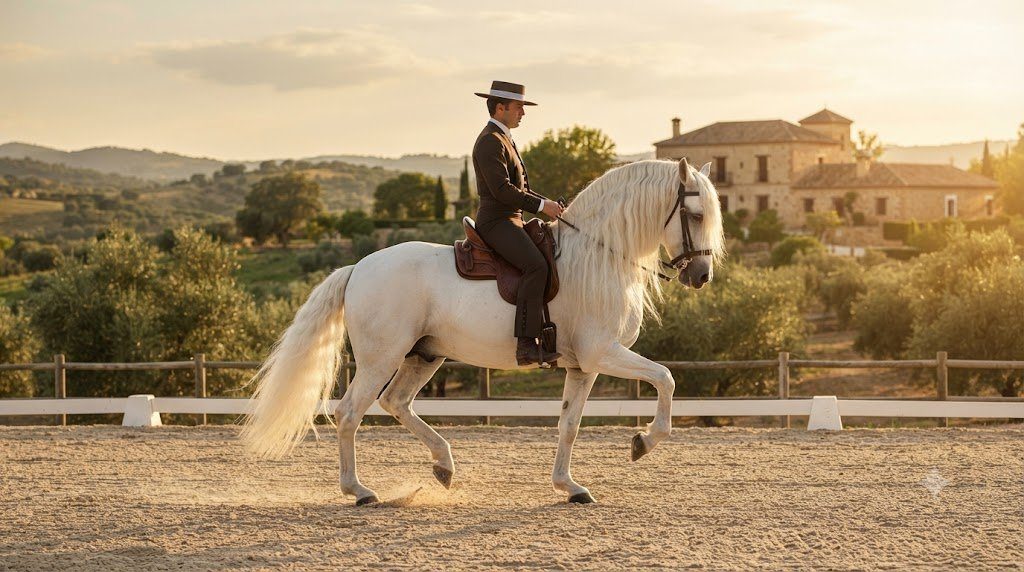
- Iberian Baroque: Andalusian (PRE) & Lusitano (PSL): Native to the Iberian Peninsula (Spain’s Andalusia and Portugal). Renowned for convex Roman profiles, thick cresty arched necks, powerful croups with low-set tails, and a high center of collection. The Pura Raza Española (PRE) was celebrated as the ‘Horse of Kings’ for classical dressage, while the Lusitano was refined for mounted bullfighting (rejoneo) requiring split-second athletic evasions.
2. Comparative Footfall Biomechanics of Specialized Equine Gaits
The biomechanical brilliance of gaited horses lies in the absence of an airborne suspension phase. In a standard trot, both diagonal feet leave the ground simultaneously, dropping the horse and rider onto the opposite diagonal pair with jarring vertical concussion. In contrast, four-beat gaits maintain at least two or three feet on the ground at all times, gliding the rider smoothly forward:
3. The DMRT3 Nonsense Mutation and Gait Expression Genetics
DNA testing for the DMRT3 ‘Gait Keeper’ allele (tested via UC Davis Veterinary Genetics) categorizes horses into three genotypes that dictate their natural gait spectrum:
- Homozygous Mutated ($A/A$ Genotype): Present at nearly 100% frequency in Tennessee Walking Horses, Missouri Fox Trotters, Paso Finos, and Standardbred pacers, and at high frequency in five-gaited Icelandic horses. Horses with the $A/A$ genotype perform four-beat ambling gaits or lateral pacing effortlessly from birth and rarely perform a square, symmetric trot.
- Heterozygous ($C/A$ Genotype): Common in four-gaited Icelandic horses, Rocky Mountain Horses, and Standardbred trotters. Can perform smooth four-beat gaits (tölt or running walk) but retain the ability to perform a clean two-beat diagonal trot with proper training.
- Homozygous Wild-Type ($C/C$ Genotype): Present in Thoroughbreds, Quarter Horses, Arabians, Warmbloods, and Iberian Andalusians. Physically unable to coordinate lateral ambling gaits; limited strictly to walk, trot, and canter.
The Horse Protection Act (HPA) and Elimination of ‘Soring’
In the show-ring Tennessee Walking Horse industry, an unethical faction historically utilized chemical and mechanical ‘soring’ (applying mustard oil, kerosene, or heavy stacked pads and action chains to sensitive front pasterns) to force horses to snatch their front feet high into an exaggerated ‘Big Lick’ gait. Federal USDA enforcement under the Horse Protection Act (HPA) inspects for scar-rule violations and banned chemical agents. Responsible pleasure and performance breeders celebrate the natural, bare-footed ‘Plantation Flat-Shod’ Walking Horse, whose smooth running walk is 100% genetic, comfortable, and sound.
4. Natural Plantation Farriery vs. Weighted Package Biomechanics
Shoeing a gaited trail horse requires farriery principles that support natural movement without distorting limb biomechanics:
- Flat-Shod Plantation Angles: A natural Tennessee Walker or Fox Trotter should be trimmed to a normal 50° to 52° front hoof angle and 53° to 55° hind angle, matching the natural hoof-pastern axis. The hoof toe length must remain moderate (3.25 to 3.75 inches); allowing toes to grow excessively long delays breakover and strains the deep digital flexor tendon.
- Shoe Weight & Weight Distribution: Pleasure gaited horses are shod with flat, lightweight steel (such as 3/8 x 3/4-inch keg shoes) or left completely barefoot. A slightly heavier front shoe can assist horses that tend to pace, encouraging them to break over into an even four-beat running walk, while horses that are too ‘trotty’ benefit from slightly lighter front shoes and rounded toes.
- Overstride Protection: Because a high-quality Walking Horse or Fox Trotter exhibits an overstride of 12 to 24 inches (the hind foot steps well past the imprint of the front foot on the same side), farriers bevel and roll the heels of the front shoes so that if a hind foot steps forward, it does not snatch off the front shoe. Bell boots are recommended during training.
5. Iberian Baroque Biomechanics: Lumbosacral Angulation and Classical Haute École
The Andalusian (Pura Raza Española – PRE) and Lusitano (PSL) represent the architectural opposite of long-backed, lateral-gaited horses. They possess a high, arched neck emerging nearly vertically from deep shoulders, a short, powerful lumbosacral junction, and a low, sloping croup with strong hip engagement:
This morphology gives Iberian Baroque horses an innate biomechanical ability for collection (shifting center of gravity backward onto flexed hindquarter hocks and stifles). In classical dressage (practiced at the Royal Andalusian School of Equestrian Art in Jerez and the Portuguese School of Equestrian Art in Lisbon), Baroque horses master the Piaffe (cadenced trot in place), Passage (elevated, suspended trot), and the famous classical ‘airs above the ground’: the Levade (holding a 45-degree rearing balance entirely on bent hindquarters), Courbette, and Capriole (leaping vertically into the air and kicking out horizontally with both hind legs).
6. Frequently Asked Questions (Technical Gaited & Baroque Horse FAQ)
Q: What is the DMRT3 gene, and how does it explain why some horses can gait while others cannot?
DMRT3 (the ‘Gait Keeper’ gene) encodes a transcription factor in spinal cord dI6 interneurons that coordinate left-right limb alternations. A nonsense mutation truncates this protein, altering neuronal firing so that the horse can move its limbs in independent four-beat lateral or diagonal sequences at high speed without being forced to break into a rough trot or canter.
Q: How does the running walk of a Tennessee Walking Horse differ from a standard trot?
A trot is a two-beat diagonal gait with an airborne suspension phase where opposite diagonal pairs strike the ground together, creating vertical bounce. The running walk is an even, lateral four-beat gait with zero airborne phase—meaning at least two feet are always on the ground, sliding forward with a rhythmic head nod and zero vertical concussion to the rider.
Q: What is ‘overstride’ in a gaited horse, and why is it prized by judges and riders?
Overstride occurs when the hind foot steps forward and lands several inches to over a foot ahead of the ground mark left by the front foot on the same side. A long, smooth overstride (12 to 24 inches) acts like a shock absorber, maximizing forward propulsion and smoothness across rugged terrain.
Q: What is the difference between a Spanish Andalusian (PRE) and a Portuguese Lusitano (PSL)?
Historically sharing ancient Iberian roots as the ‘Andalusian,’ the breeds split in 1966 into separate studbooks: the Spanish Pura Raza Española (PRE) was bred primarily for classical dressage carriage, animated knee action, and refined elegance. The Portuguese Lusitano (PSL) was selected heavily for mounted bullfighting (rejoneo), featuring a slightly more convex Roman profile, heavier jaw, and explosive agility.
Q: Can a gaited horse canter, or are they only able to walk and gait?
Yes, all gaited horses can canter! A properly trained Tennessee Walking Horse or Missouri Fox Trotter performs a true, rhythmic three-beat canter with a smooth rocking-chair motion. A poor gait trainer who only pushes for speed without balance can produce an uncoordinated, four-beat ‘pace-canter,’ but correct classical riding produces a lovely three-beat canter.
Q: What is the ‘Fox Trot’ gait of the Missouri Fox Trotter?
The Fox Trot is a diagonally broken four-beat gait where the horse walks with its front feet and trots with its hind feet. The front foot lands a fraction of a second before the diagonal hind foot, and the hind foot slides forward over the track of the front foot, giving the rider a gentle, smooth gliding sensation on rocky Ozark trails.
Q: Why are grey Andalusians prone to Melanomas, and how are they managed?
Over 75% of grey horses carrying the dominant Grey gene (G) develop dermal melanocytomas around the perineum, tail base, and parotid salivary glands by 15 years of age. Research shows the Grey mutation causes melanocyte hyper-proliferation. Modern veterinary medicine manages these with surgical diode laser excision and autologous or DNA melanoma vaccines.
Q: What is the ‘Paso Fino’ gait, and why is it demonstrated on a wooden sounding board?
The Paso Fino performs the Classic Fino, an ultra-rapid, perfectly rhythmic four-beat lateral gait with very short forward stride length. In competition, horses are ridden across a 100-foot wooden sounding board (la tabla de resonancia), where judges listen for a crystal-clear, unbroken, rapid-fire staccato rhythm with zero hesitation or asymmetry.