Heavy draft and carriage horse breeds—commanded by the American and Brabant Belgian Draft, the French Percheron, the Scottish Clydesdale, the English Shire, the Suffolk Punch, and the royal Dutch Friesian—represent the pinnacle of equine draft tractive biomechanics, calm non-reactive temperament (‘cold-blooded’ neurobiology), and massive bone density. Weighing between 1,800 and 2,500+ pounds, a conditioned draft team can exert an instantaneous tractive pull exceeding 3,000 to 4,500 pounds, serving as the power behind modern sustainable forestry, commercial hitch show competition, regenerative horse-drawn agriculture, and carriage tourism. Mastering draft skeletal lever angles, the genetics of Polysaccharide Storage Myopathy Type 1 (PSSM1) in Belgians and Percherons, Chronic Progressive Lymphedema (CPL) feathering pathology in Shires and Clydesdales, and low-starch high-fat ration formulation is vital for heavy horse stewardship.
The Draft Shoulder Incline Angle & Collar Traction Physics
Unlike riding sport horses where a sloping 45-degree to 50-degree shoulder angle is selected for elastic forward reach and shock absorption, heavy draft horses are selected for a more upright, muscular 55-degree to 60-degree scapular angle. This upright shoulder geometry provides a solid, flat skeletal shelf against which the leather draft collar and wooden hames can seat securely without compressing the jugular groove or trachea, allowing the horse to lean its massive body weight forward and drive directly from the hindquarters through the trace chains.
1. Historical Evolution, European Working Roots, and Breed Standards
Heavy draft breeds descend from the massive ‘Great Horses’ of medieval Europe (the Flemish Horse and Boulonnais), bred originally to carry armored knights and later refined during the 18th and 19th centuries as the agricultural and industrial locomotives of Western civilization:
- Belgian Draft (American Belgian vs. European Brabant): Originating in the fertile agricultural lowlands of Belgium. The traditional European Brabant remains a short-legged, massive, heavy-boned draft horse with extensive leg feathering and deep red-roan or bay coloring. American breeders selectively evolved the American Belgian (founded in Wabash, Indiana, in 1887) into a taller, cleaner-legged, sorrel/chestnut horse with a flaxen mane and tail, representing over 65% of all registered draft horses in North America and dominating modern pulling contests.
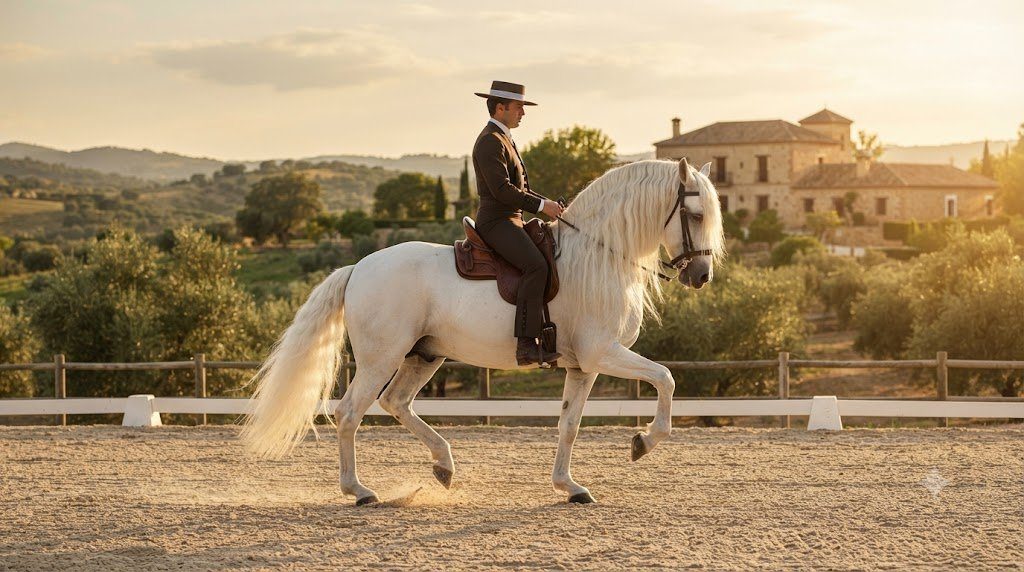
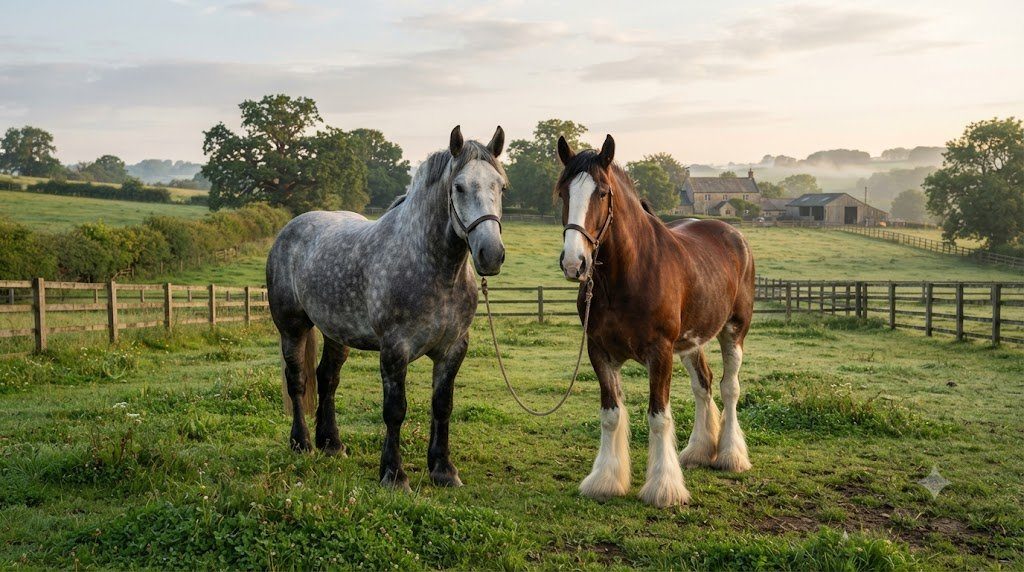
- Percheron: Developed in the fertile Le Perche province of northwestern France (southwest of Paris). Heavy Arabian stallion infusions in the 18th century into native heavy stock produced a draft horse renowned for clean, unfeathered legs, animated trotting action, and elegant arched crest. Ranging from 16.2 to 18.0 hands, Percherons are registered strictly in two coat colors: solid jet-black or dapple-grey (which whitens with age).
- Clydesdale: Developed along the River Clyde in Lanarkshire, Scotland, by the Duke of Hamilton and local farmers in the early 18th century by crossing Flemish stallions onto Scottish mares. World-famous for their high-stepping parade action, wide blaze, and long, silky white hair (‘feather’) flowing from the back of the knees and hocks, Clydesdales dominate commercial hitch exhibitions (most famously the Budweiser Clydesdales).
- Shire: The tallest and heaviest horse breed on earth, originating in the Fen country and midland counties of England (descended from the British Packington Blind Horse of 1755). Shires frequently exceed 18.0 to 19.2 hands (up to 6 feet 4 inches at the withers) and 2,400 pounds, displaying massive flat bone (cannon bone circumference exceeding 11 to 12 inches), deep Roman noses, and heavy leg feathering.
- Friesian (KFPS): One of Europe’s oldest native breeds, originating in Friesland in the northern Netherlands. Not a field plow draft horse, but a royal carriage and high-stepping baroque riding horse. Characterized by 100% solid black coat (with zero white markings permitted in the main studbook), abundant wavy mane and tail reaching the ground, upright neck carriage, and elevated, suspended trot trot mechanics.
2. Comparative Draft Horse Morphometrics and Tractive Benchmarks
Evaluating the five premier heavy breeds illustrates the contrast between brute pulling leverage (Belgian), parade animation (Clydesdale/Shire), and carriage cadence (Percheron/Friesian):
In North American heavy pulling contests (governed by dynamic dynamometer stone-boat trucks), a conditioned 4,500-pound pair of American Belgian draft geldings can exert a dead-weight tractive pull of 4,200 pounds for 27.5 feet—equivalent to moving an unbraked 54,000-pound semi-truck on dry pavement through pure hindquarter biomechanical torque.
3. Chronic Progressive Lymphedema (CPL) and Feathering Histopathology
A devastating, progressive, and incurable chronic disease affecting heavily feathered draft breeds—specifically Shires, Clydesdales, Belgian Brabants, and Gypsy Vanners—is Chronic Progressive Lymphedema (CPL):
The Genetic and Histological Mechanism of CPL
Research at UC Davis Veterinary Medicine revealed that CPL is an inherited systemic elastin dysplasia affecting the lymphatic vasculature of the distal limbs. Defective elastin fibers cause lymphatic vessels to dilate, fail, and leak protein-rich lymph into the subcutaneous tissues of the lower pasterns and cannons. The stagnant lymph induces chronic inflammation, secondary Chorioptic mange mite infestation (Chorioptes bovis), bacterial cellulitis, and massive skin thickening into rock-hard circumferential fibrous folds, nodules, and foul ulcerations. While clean-legged Percherons and American Belgians are rarely affected, feathered breeds require lifetime management: clipping feathers for topical mite treatment, daily exercise to promote venous lymph return, and manual lymphatic drainage bandaging.
4. Polysaccharide Storage Myopathy (PSSM1) in Belgian and Percheron Lines
Genetic screening across North American and European draft breeds reveals a high carrier frequency of the PSSM1 (GYS1 R309H) mutation—present in 35% to 40% of American Belgians and 15% to 20% of Percherons. Because draft horses have massive Type IIA muscle volume, the abnormal accumulation of amylase-resistant glycogen and polyglucosan bodies triggers insidious clinical signs:
- Clinical Signs in Draft Horses: Unlike light horses that show acute, violent ‘tying-up’ sweating episodes, draft horses with PSSM1 frequently exhibit chronic low-grade symptoms: difficulty picking up hind feet for the farrier, shivering/tremoring of the hind limbs when standing tied, reluctance to back up, loss of topline muscling, and recumbency (‘downer horse’) after a long day of plowing.
- Mandatory DNA Testing & Strict Low-Starch Management: Breed associations encourage testing to avoid carrier-to-carrier matings. Horses testing positive ($N/PSSM1$ or $PSSM1/PSSM1$) are successfully managed by completely eliminating all grain, corn, oats, and sweet feeds, maintaining dietary Non-Structural Carbohydrates (NSC) strictly below 10% to 12%, and supplying 15% to 20% of daily digestible energy as pure fat/oil (1 to 2 cups of canola oil or high-fat rice bran daily).
5. Low-Energy-Density Nutrition, Hindgut Fermentation, and Colic Prevention
A 2,000-pound draft horse requires a staggering quantity of daily forage—consuming 35 to 50 pounds of dry matter daily (1.8% to 2.2% of body weight). However, their metabolic rate is remarkably efficient:
Draft horses have a lower maintenance energy requirement per pound of body weight than light Thoroughbreds or Arabians. Feeding rich, high-protein legume hay (pure alfalfa) or large starch meals to non-working draft horses causes massive obesity, cresty neck development, Equine Metabolic Syndrome (EMS), and severe laminitis (founder). Ideal draft forage consists of clean, dust-free mid-maturity grass hay (timothy, brome, or orchardgrass) supplemented with a concentrated Ration Balancer pellet (1 to 2 lbs/day) providing essential lysine, methionine, copper, zinc, selenium, and Vitamin E without unnecessary starch calories.
6. Tractive Farriery: Scotch Bottom Shoes, Caulks, and Pastern Biomechanics
Draft farriery is a heavy-duty, highly specialized biomechanical craft: a single draft horseshoe can weigh 3.5 to 5.5 pounds of solid steel, requiring size 8 to 12 draft nails:
- Work Shoes with Drive Caulks (Traction Farriery): For working in muddy timber woods, ice, or plowed agricultural fields, draft horses wear heavy steel shoes equipped with welded toe grabs and screwed-in tungsten carbide drive caulks (calks) on the heels. Caulks elevate the heel and bite into frozen ground or mud, giving the horse slip-free traction to pull massive timber loads without tearing suspensory ligaments.
- Scotch Bottom Shoes (Show Hitch Exhibition): For Clydesdales, Shires, and Percherons competing in 6-horse and 8-horse hitch show rings, farriers craft wide-web Scotch Bottom shoes with bevelled outer edges and thick leather or polyurethane pads. The wide-flared base provides optical symmetry and forces the hoof to break over flat and straight, accentuating the dramatic high-stepping knee and hock action demanded by show judges.
7. Frequently Asked Questions (Technical Heavy Draft Horse FAQ)
Q: What is the difference between an American Belgian and a European Brabant draft horse?
While sharing foundational Belgian roots, European Brabants were preserved as extremely heavy, compact, low-to-the-ground plow horses (standing 15.2 to 16.2 hands with dense bone and thick leg feathering). American Belgians were bred taller and leaner (17 to 18.2 hands) with clean, unfeathered legs and light sorrel/flaxen coloring to move faster in hitch hitches and farm machinery.
Q: Why do Clydesdales and Shires have long hair on their lower legs, and what health problem does it cause?
Leg hair (‘feather’) evolved as natural protection against driving Scottish and English rain, mud, and brambles. However, in domestic horses, heavy feather creates a moist, warm microclimate that harbors Chorioptic mange mites and hides Chronic Progressive Lymphedema (CPL)—a genetic elastin disorder causing painful fibrotic skin folds and ulcers.
Q: How does PSSM1 affect draft horses differently than Quarter Horses?
In Quarter Horses, PSSM1 typically causes acute, sudden muscle cramping and dark urine after exercise. In heavy draft horses (Belgians and Percherons), PSSM1 frequently presents as chronic, subtle weakness: shivering/tremoring of the hind legs when held up for farriery, reluctance to back up out of a stall, loss of muscle tone over the croup, and inability to rise after lying down.
Q: Why are Percheron horses usually either black or grey, while Belgians are sorrel with flaxen manes?
Breed registry standards fixed these color genes early: French Percheron breeders selected for the dominant Extension black gene (E) and dominant Grey gene (G) inherited from 18th-century Arabian sires, while the American Belgian association favored the recessive red chestnut/sorrel gene (e/e) paired with flaxen mane and tail mutations.
Q: What is the horse-collar draft angle, and why must draft shoulders be more upright than riding horse shoulders?
Draft horses require an upright 55° to 60° shoulder angle to create a flat, supportive base of the neck for the leather draft collar to rest against. If a draft horse had a sloping 45° riding shoulder, pulling heavy loads would cause the collar to slide upward and choke the trachea, cutting off airflow.
Q: How much feed and water does a working 2,000-pound draft horse consume per day?
A working draft horse consumes 40 to 50 pounds of good-quality grass hay daily (roughly 2% of body weight in dry matter) and drinks 20 to 30 gallons of water per day (surging to 40+ gallons during hot summer plowing). High-fat rations (oil/beet pulp) provide concentrated non-heating calories without overloading the gut with starch.
Q: Can purebred Friesian horses have white markings or colors other than black?
Under strict Koninklijke Vereniging ‘Het Friesch Paarden-Stamboek’ (KFPS) registry rules, purebred Friesians must be 100% solid black. The only exception permitted is a tiny white star on the forehead (under 3 cm) in mares and geldings; breeding stallions must be 100% jet-black with zero white hairs.
Q: Why are Clydesdales preferred over Belgians for commercial parade hitches like the Budweiser team?
Clydesdales possess a unique ‘close-hocked’ hind leg conformation and long, flexible pasterns that produce a high, springy, animated trot where the horse lifts its knees to horizontal and flashes clean white feathering with every stride. Belgians are heavier pullers, but move with a lower, ground-covering working stride.